Showing posts with label marie stopes. Show all posts
Friday, 6 February 2009
Meet Edith How-Martyn
Edith lived in a time when women's education was beginning to be taken more seriously. She had a fab education as a result, first attending the North London Cllegiate School for Girls, a school formed and run by Frances Buss, an early supporter of women's suffrage, followed by attending University College, Aberystwyth, where she obtained her degree. She became a lecturer of Mathematics at Westfield College. However, this came to an end when she married Herbert Martyn. On the same note though, she did keep her maiden name and joined with that of her husbands. A fair concession I think.
Edith How-Martyn was an early recruit to the Women's Social and Political Union (WSPU) and was arrested in 1906 for attempting to make a speech in the lobby of the House of Commons. She was one of the first members of the organisation to be sent to prison. Not long after this, How-Martyn became critical of the dictatorial way that the Pankhursts led the WSPU without consulting any of the other members of their next actions. At a meeting in October 1907, Edith How-Martyn, Teresa Billington-Grieg, Charlotte Despard and seventy other women attempted to make the WSPU a more democratic organisation. It failed.
Edith, joined by Charlotte and Teresa, left the WSPU and formed the Women's Freedom League. This new organisation still took a very militant approach, but instead concentrated on using non-violent illegal methods such as not paying taxes and abstaining from the 1911 consensus. After the passing of the Qualification of Women Act, Edith stood as an independent feminist candidate in the 1918 General Election, but was unsuccessful. Edith had more success when she stood for the Middlesex County Council and became its first female member.
During and particularly after the First World War Edith became active in the campaign for birth-control like Marie Stopes. Edith, too, was particularly concerned about working-class women who had little information how to control the size of their families. Unlike Stopes, however, Edith worked closely with Margaret Sanger, the American counterpart advocating birth-control. She met Sanger in 1915 and Margaret got on considerably better with Edith than Marie Stopes, who believed that Sanger was only a challenge to her limelight.
Both Edith and Margaret worked together to organise the World Population conference in Geneva in 1927. In 1929 they founded the Birth Control International Information Centre (BCIIC) to spread birth-control knowledge. Edith travelled extensively around Asia to promote the use of birth-control, and in particular India where she tried building up a network of birth-control providers and activists.
Unfortunately, their international work was interrupted as the Second World War spread through Europe. Plagued by lack of funds and staffing problems, the London centre was shut down in 1937. When the war spread to England, the How-Martyns fled to Australia. After the war, Edith's health problems prevented her from returning to Britain. She died in a Sydney nursing home on February 4, 1954.
Labels:
birth control,
Edith How-Martyn,
Margaret Sanger,
marie stopes,
Pankhursts,
WSPU
Friday, 7 November 2008
"Wine that turned to Vinegar"
To have loved, to have kissed
And- oh, God!- to have missed
The completion of Love!
To have turned to one
As the only sun
In one's sky above
And to find that his beams
Had merely in dreams
Their radiant light.
What so deep as the woe
Of those who did know
The joy of the height.
A more powerful thing
Than the broken wing
Of a bird that soared,
Is one driven by fate
To return with hate
Where she once adored.
Marie Stopes... of course! 1909
And- oh, God!- to have missed
The completion of Love!
To have turned to one
As the only sun
In one's sky above
And to find that his beams
Had merely in dreams
Their radiant light.
What so deep as the woe
Of those who did know
The joy of the height.
A more powerful thing
Than the broken wing
Of a bird that soared,
Is one driven by fate
To return with hate
Where she once adored.
Marie Stopes... of course! 1909
Saturday, 30 August 2008
STOPES/CHAPTER I PART I: A Woman's Right to Orgasm: Equality and Mutuality in Marriage
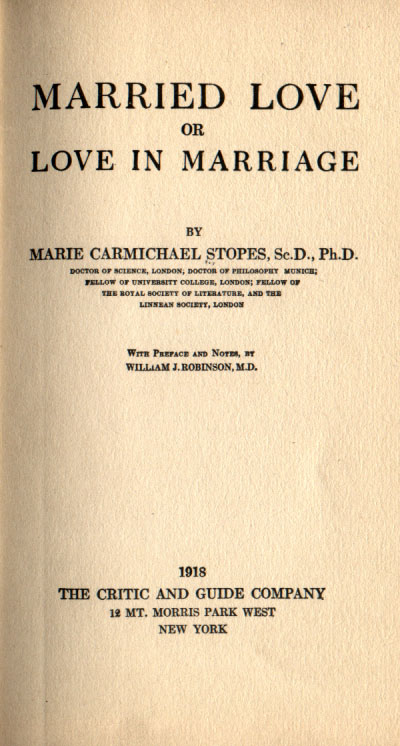
Marie Stopes wrote Married Love to “electrify England” and it succeeded in its task. By 1937 820,000 copies were sold worldwide. Her book was not the first or last manual on marriage and sex, but, as Hera Cook states, it transformed the discourse on heterosexual female sexuality and sexual practice. Stopes had no tradition to draw from to construct the ideology of an independent and emotionally active female sexual identity, which was formed separately from their reproductive capacity and from male’s sexuality. Creating a female sexual identity and role separate from reproduction was a major innovation. Before the development of effective contraceptives, nineteenth-century sex and marriage manual authors placed sexual activity alongside reproductive physiology reflecting a connection between sexual and reproductive roles for women. Birth-control was the crux of ‘married love’ which allowed pleasurable sex without hindrance of conception. Married Love was sparse in conveying details about birth-control because Stopes wanted to keep women’s sexual and reproductive roles separate. It was Wise Parenthood published later in the same year that provided the necessary details.
Married Love was unique in that the response Stopes received from women was phenomenal. Thirty-three respondents from the sample of letters studied wrote to Stopes to express their gratitude that finally someone seemed to understand not only the sex relations but the marriage relationship too: “it seems so wonderful to think that someone really knew love and understand as we do.” Married Love was written to promote equal and mutual enjoyment of sex which would provide a basis for a happy, successful marriage. Stopes noted that she knew that “in the middle classes in this country, marriage is far less happy than its surface appears” and it is no easy task to produce a successful marriage, especially when ignorance reigns causing despondency and ruptures in marriages all over England. Stopes established women’s sexuality and formed a sexual role for women within marriage, which was a departure from Victorian ideals that proposed women had no sexual feeling at all. Women in the past have been modelled to represent their husbands’ and society’s ideal wifely qualities:
"Woman’s side of the joint life has found little or no expression. Woman has been content to mould herself to the shape desired by man wherever possible."
The foundation of Stopes’ ideology in Married Love is that men and women are equal in marriage: “we are incomplete in ourselves; neither man nor woman can singularly know the joy of the performance of all the human functions”. Stopes argues that women should be treated as equal, intelligent and sexual beings. The notion that “sex-life is a low, physical, and degrading necessity which a pure woman is above enjoying” is completely rejected by Stopes as a “deeply rooted” social construction based on the idea that female ‘ignorance’ was really an indication of ‘innocence’ and ‘purity’, as one respondent highlights: “Parents, confusing “ignorance” with “innocence” are eternally threatening their daughters in the belief that ignorance combined with fear will safeguard their chastity.” Stopes argued that women were sexual creatures who had a right to satisfaction as well as men:
"Welling up in her are the wonderful tides, scented and enriched by
the myriad experiences of the human race from its ancient days of
leisure and flower-wreathed love-making, urging her to transports
and to self-expressions..."
Stopes showed that women could be sexual beings and it was above all natural. It was not depraved for women to want and enjoy sex.
Stopes argued that man has “used woman as his instrument so often regardless of her wishes” and he should alter his sexual technique to accommodate his wife’s needs. Even many feminists remained disinterested in questions related to female sexuality, which makes Stopes rather progressive in comparison to her contemporaries. Feminists’ main sexual issue was to emphasise a high moral code for women based on a belief in sexual control and chastity upon men. Stopes did adopt the idea that men should restrain themselves, as “it is his duty to do so, not only when his wife is ill, but also during menstruation and pregnancy”, but rejected other feminists’ endorsement of abstinence as women were sexual beings too and it would deprive women of the healthy benefits of sex. This revolutionises the perception of women in society from asexual acquiescent wife to an individual with sexual feelings parallel to a man. Stopes hoped the propagation of her ideology would diverge from the tradition of woman being used by her husband in the name of ‘marital rights’, which Stopes acknowledged that law and custom had strengthened. The husband had “the right to approach his wife whenever he wishes, and that she has no wishes and no fundamental needs in the matter at all.” Stopes combated this long-standing social construction with her Law of Periodicity of Recurrence of Desire in women. This law stated that women had ‘sex-tides’ and felt naturally more aroused at certain times of the month than others and the man was to use this tide to gauge his sexual approaches. The Law of Periodicity gave a biological mandate both to women’s rejection of a husband’s demands for sexual intercourse and to Stopes’ claim that women could desire sex for pleasure. It meant that women could desire sex at times determined by themselves and could ‘submit’ to their husband’s demands without being “lowered” but still maintaining the right to refuse on other occasions. This ultimately gave women the right to control the frequency and timing of sexual relations. Stopes argued that for the husband to enjoy the sex act and make his marriage a happy, contented relationship of harmony, companionship and love, he should always seduce his wife: “The supreme law for husbands is: Remember that each act of union must be tenderly wooed for and won, and that no union should ever take place unless the woman also desires it and is made physically ready for it.” Stopes explained that if a man disregards his wife’s wishes then “it is rape for the husband to insist on his marital rights” and subsequently he will make the act repugnant to her thereafter. This radical idea was increasingly adopted in the interwar period by feminists, but Stopes made it respectable by explaining that ‘married love’ and successful marriages depended on this equal negotiation between partners.
Married Love was unique in that the response Stopes received from women was phenomenal. Thirty-three respondents from the sample of letters studied wrote to Stopes to express their gratitude that finally someone seemed to understand not only the sex relations but the marriage relationship too: “it seems so wonderful to think that someone really knew love and understand as we do.” Married Love was written to promote equal and mutual enjoyment of sex which would provide a basis for a happy, successful marriage. Stopes noted that she knew that “in the middle classes in this country, marriage is far less happy than its surface appears” and it is no easy task to produce a successful marriage, especially when ignorance reigns causing despondency and ruptures in marriages all over England. Stopes established women’s sexuality and formed a sexual role for women within marriage, which was a departure from Victorian ideals that proposed women had no sexual feeling at all. Women in the past have been modelled to represent their husbands’ and society’s ideal wifely qualities:
"Woman’s side of the joint life has found little or no expression. Woman has been content to mould herself to the shape desired by man wherever possible."
The foundation of Stopes’ ideology in Married Love is that men and women are equal in marriage: “we are incomplete in ourselves; neither man nor woman can singularly know the joy of the performance of all the human functions”. Stopes argues that women should be treated as equal, intelligent and sexual beings. The notion that “sex-life is a low, physical, and degrading necessity which a pure woman is above enjoying” is completely rejected by Stopes as a “deeply rooted” social construction based on the idea that female ‘ignorance’ was really an indication of ‘innocence’ and ‘purity’, as one respondent highlights: “Parents, confusing “ignorance” with “innocence” are eternally threatening their daughters in the belief that ignorance combined with fear will safeguard their chastity.” Stopes argued that women were sexual creatures who had a right to satisfaction as well as men:
"Welling up in her are the wonderful tides, scented and enriched by
the myriad experiences of the human race from its ancient days of
leisure and flower-wreathed love-making, urging her to transports
and to self-expressions..."
Stopes showed that women could be sexual beings and it was above all natural. It was not depraved for women to want and enjoy sex.
Stopes argued that man has “used woman as his instrument so often regardless of her wishes” and he should alter his sexual technique to accommodate his wife’s needs. Even many feminists remained disinterested in questions related to female sexuality, which makes Stopes rather progressive in comparison to her contemporaries. Feminists’ main sexual issue was to emphasise a high moral code for women based on a belief in sexual control and chastity upon men. Stopes did adopt the idea that men should restrain themselves, as “it is his duty to do so, not only when his wife is ill, but also during menstruation and pregnancy”, but rejected other feminists’ endorsement of abstinence as women were sexual beings too and it would deprive women of the healthy benefits of sex. This revolutionises the perception of women in society from asexual acquiescent wife to an individual with sexual feelings parallel to a man. Stopes hoped the propagation of her ideology would diverge from the tradition of woman being used by her husband in the name of ‘marital rights’, which Stopes acknowledged that law and custom had strengthened. The husband had “the right to approach his wife whenever he wishes, and that she has no wishes and no fundamental needs in the matter at all.” Stopes combated this long-standing social construction with her Law of Periodicity of Recurrence of Desire in women. This law stated that women had ‘sex-tides’ and felt naturally more aroused at certain times of the month than others and the man was to use this tide to gauge his sexual approaches. The Law of Periodicity gave a biological mandate both to women’s rejection of a husband’s demands for sexual intercourse and to Stopes’ claim that women could desire sex for pleasure. It meant that women could desire sex at times determined by themselves and could ‘submit’ to their husband’s demands without being “lowered” but still maintaining the right to refuse on other occasions. This ultimately gave women the right to control the frequency and timing of sexual relations. Stopes argued that for the husband to enjoy the sex act and make his marriage a happy, contented relationship of harmony, companionship and love, he should always seduce his wife: “The supreme law for husbands is: Remember that each act of union must be tenderly wooed for and won, and that no union should ever take place unless the woman also desires it and is made physically ready for it.” Stopes explained that if a man disregards his wife’s wishes then “it is rape for the husband to insist on his marital rights” and subsequently he will make the act repugnant to her thereafter. This radical idea was increasingly adopted in the interwar period by feminists, but Stopes made it respectable by explaining that ‘married love’ and successful marriages depended on this equal negotiation between partners.
Stopes propagated the woman’s right to orgasm within the sexual relations of marriage. The removal of sexual intercourse from the notion that it was for procreation to the idea that it could and should be pleasurable for women was revolutionary. Women’s sexuality was now firmly established in its own right separately from that of the woman’s reproductive capacity. Stopes advocated “mutual adjustment”, which is “where the two are perfectly adjusted” and can reach a mutual orgasm. This equal share of enjoyment in sex is truly significant as women become equal to men in sexual relations. Stopes breached boundaries that had never been crossed by other sex and marriage manual authors before. She discussed the husband’s inability to abstain the moment of orgasm until his wife was ready: “the man’s climax comes so swiftly that the woman’s reactions are not nearly ready. And she is left without it.” Stopes severely criticised coitus interruptus because it meant that women were left “in ‘mid-air’” and therefore unsatisfied. Although men get the complete sex-act through coitus interruptus, it deprives women of the man’s secretions, which Stopes claimed were beneficial to a woman’s health. To stop this Stopes stressed the idea that men should alter their sexual technique to increase female sexual pleasure focusing on foreplay and prolonged intercourse enabling women to have the benefit of an orgasm without the concern of becoming pregnant because the married couple would be practicing birth-control.
F.Y.I: This is copyrighted ©
Labels:
birth control,
enduring love,
husbands,
marie stopes,
marriage,
Married Love,
orgasm,
sex,
womanhood
Friday, 29 August 2008
Introduction to Marie Stopes- My dissertation 'marvel'!!!

As a famous paleobotanist, notorious author, birth-control pioneer, eugenicist and feminist, Marie Stopes was certainly a controversial character. Sex education and birth-control is something many of us take for granted today. Where would society be today if women could not restrict the number of children they had? Many would pinpoint the 1960s as the watershed in contraceptive technology and promotion, but it was from the late nineteenth-century that birth-control began to be considered as a serious social movement in the British Isles. Marie Stopes personalised the movement and promoted birth-control by constantly publicising herself, her works and her clinics. She not only achieved more than any other birth controller, but revolutionised marital relations and motherhood, which changed women’s lives.
Marie Stopes lived in a time of great social change for women in England. The feminists’ pre-war political efforts and women’s war effort resulted in women being emancipated in 1918. The following year a Sex Disqualification Removal Act was introduced, opening higher levels of civil service, legal professions and jury duty to women.
N.B. However, the political emancipation was restricted to women who were above the age of thirty, owned property or were the wives of householders or occupied property with the annual rate of £5 and had a graduate degree. It was by no means universal suffrage, as it is clearly restricting voting rights to middle class women, unlike men who, no matter their class, could vote.
These gains combined to raise the question of a possible increase in female opportunities and Married Love (1918) was published amongst this expansion of political and economic opportunities for women. With Stopes promoting sexual pleasure, it seemed a revolutionary time for middle-class women.
The first half of the twentieth-century was also a time for heightened eugenics fear. The emancipation of some women paralleled the increased anxiety on the ‘Condition of England’ question. Reconciling women’s demands for greater political and economic equality with the needs of the race was one of the most troublesome eugenicist issues. Independent women were eschewing the typical domestic role as wife and mother. The Great War was a eugenics nightmare. It supposedly destroyed the finest physical and mental stock of the nation and disrupted family life and selective reproduction. In Britain there was a particular emphasis on the idea that certain areas of the working-class were degenerating the nation. There were variants of eugenic principles. The worst was ‘negative’ eugenics, which was more authoritarian and used coercive measures to decrease the propagation of ‘bad stock’ and was based on racism, and classism to produce a strong ‘race’. Stopes combined the ‘negative’ principles with ‘positive’ principles, which promoted those who she considered ‘good stock’ to have more children. She had strong eugenic principles and was a member of the Eugenics Society, but she participated in the middle-class feminist movement. Stopes combined these two strains of influence to form an agenda that she thought would benefit all women. This dissertation will argue whether her eugenics or latent feminist principles steered the course of her work and whether she revolutionised society through her ideology on marital relations, publicity of sexual knowledge and promotion of birth control.
Marie Stopes has not suffered from historical neglect. There have been four biographies on her, two of which were from very close friends and their objectivity has been questioned. The first biography was written by her ‘would-be lover’, Aylmer Maude in 1924 and he clearly admires her, which no doubt contributing to Stopes’ publicity campaign. The second biography was written by Keith Briant in 1962. He was another of her ‘would-be’ lovers and writes from a sentimental point of view four years after Stopes’ death. Neither of these biographies historically analyses Stopes and talk of her objectively. The third was written by Ruth Hall (Passionate Crusader, 1977). She is a journalist and she focuses on Stopes’ sexual and emotional experience that provoked her varied career. She just assumes that Stopes helped women with their sexual, marital and contraceptive needs and focused very little on Stopes’ role in the birth-control movement. June Rose, a professional biographer, wrote Marie Stopes and the Sexual Revolution (first ed. 1992), which focuses on Stopes interweaving public and private life.
My dissertation is an analysis of how revolutionary Stopes’ work was on changing marital relations, sexual knowledge, and promoting birth-control. I will not discuss why there was a fertility decline or why limiting births happened uniformly in Great Britain. I intend to explore women as one gender and discuss to what extent Stopes revolutionised social ideals of marriage, sex and birth-control. Women have never been looked at as a whole by previous historical analysis. Contrasting the class variations of Stopes’ influence will give a more balanced overview of her work revolutionising women’s role within marriage and society. I have contrasted Stopes’ works and her correspondence to see how influential her ideology was on women and if it changed society, which has not been explored before. I will also study the conflict between Stopes’ eugenicist principles and her concern for women’s health and happiness. Eugenics hugely influenced Stopes’ aims and affected the way Stopes’ helped women. Many historians have argued her to be either a feminist or a eugenicist. I believe that for Stopes they were indistinguishable, I will argue that Stopes combined her feminist and eugenicist principles. She may have had different aims, race regeneration and happy domestic life with sexual pleasure and voluntary motherhood, but there was one means: birth-control.
I study whether marriage became an equal partnership as Stopes’ promoted and whether women actually achieved sexual fulfilment. I use Stopes’ marriage manuals and correspondence to see how far her ideas of sexual fulfilment and equality in marriage were adopted across the classes. I discuss how Stopes combated sexual ignorance, which was causing unhappy marriages, high birth rates and weak, exhausted mothers. I examined what Stopes wrote in a wide variety of books and then contrasted them to my sample of correspondence to see how many were grateful for the knowledge and asked for more information. Whether the plea for more information was an indication that the information in the books was not sufficient is discussed and how publicity, her clinics and newspaper articles contributed to the dissemination of sex and birth-control information. There is also an in-depth discussion on what steered Stopes’ promotion of birth-control; was it for the race or women’s health and happiness? I look at Cohen’s argument that the clinic was the instrument through which Stopes helped women regain control of their fertility. I have also looked at what Stopes wrote, particularly her eugenicist tract Radiant Motherhood, and how this affected her influence on reforming society for women.
Using Stopes’ own published works, there are many pitfalls. What Stopes may have publicly advocated in her books did not necessarily correlate to her actions in the clinics or in her correspondence. Stopes was a self-aggrandising publicist but her sympathetic tone in correspondence and her policies in the clinics did not show her ardent eugenicist drive as many of her books did. It is hard to know whether the sample of correspondence used in this dissertation is representative of society at the time. The respondents were predisposed to be in favour of birth-control and voluntary motherhood. The majority of respondents were middle-class therefore the other classes are disproportionately represented making it difficult to achieve a balanced overview. Despite this, it is possible to achieve an overall sense of how far Stopes revolutionised society for women. Stopes may not have helped every single woman in society, but those she did help have an experience worth studying.
The overall conclusions to be drawn from this dissertation are that Stopes was a social reformer, not a revolutionary. She tried to break social barriers that maintained sexual ignorance and publicised such topics allowing the free dissemination of information as well as changing marital relations. Stopes did help both middle and working-class women by her publicising information through different media. Those who came into direct contact with Stopes, through her work, letters and clinics were helped to gain control of their fertility. Stopes helped women but not uniformly. In hindsight it seems she stayed rather conservative, as she did not promote issues too deviant from the social norms, but in the 1920s and 1930s she was seen as controversial. Stopes was a social reformer, who through birth-control achieved her feminist and eugenicist objectives of happy marriage, voluntary motherhood, universal sexual knowledge and race regeneration. For Stopes, there was no distinguishing between her eugenicist and feminist principles, which were so intertwined.
More to follow.... mwhahahahahaha....
Labels:
1920s 1930s,
birth control,
class,
contraception,
dissertation,
eugenics,
marie stopes,
Married Love,
motherhood,
pregnancy,
sex
Subscribe to:
Posts (Atom)