On days like today I wonder... Is barreling backwards and forwards boxes of audio guides where I want to go in life?
No is the answer, but it does pay the bills (what little of them I have to pay at the moment!) and the people I work with generally always a good laugh. Still, days like today I wish there was just something with a little more substance than just ME in my life.
I am a Leo (starsign) for sure, which means I am supposed to like being the centre of attention. Now this works for me in a perverse way- I like to earn my way to be the centre of attention. I do not want to be the centre of attention just because it is my birthday for example- I have not chosen my birthday. I have not earned it therefore I do not want to be centre stage. I had this issue when dancing in competitions- If I didn't feel I earnt it or just didn't car you can bet you bottom dollar I wouldn't have danced my best! I am a buggar like that... :) However, my first degree- now I worked MY ARSE off for that so I am quite proud of that and will do my showpiece best to be in the limelight.
Otherwise I live for other people. Apart from that slight egotistical twist in my character I do prefer to live my life around others. I like to have people celebrate things and do things that I tag along to..
My basic point of this blog is that one of my friend, with two kids, is getting married next month. She is the same age as me. She has everything worked out (or at least I think she does.) I am no closer to being married (not that I want to be married necessarily) or have kids (optional) but she knows what she wants and what she is doing. She is charge of people (kids) that rule her day to day life. While I shouldn't envy her that, I do. I PREFER not to think about me. I am no closer to being a responisble adult that when I left for uni. I am still doing a studenty type job and I have no solid concrete plans.
However, one day in the near future I am sure I will regret this blog and my carefree manner when I have a life of too much responisbility and full of kids and partners needs. Still, today, I feel like a teenager.
Rant over :)
Showing posts with label marriage. Show all posts
Showing posts with label marriage. Show all posts
Friday, 22 May 2009


Thursday, 2 October 2008
A solemn thing- it was- I said-
A solemn thing- it was- I said-
A woman- white- to be-
And wear- if God should count me fit-
Her blameless mystery-
A hallowed thing- to drop a life-
Into the purple well-
Too plummetless- that it return-
Eternity- until-
I pondered how the bliss would look-
And would it feel as big-
When I could take it in my hand-
As hovering-seen through fog-
And then- the size of this "small" life-
The Sages- call it small-
Swelled- like Horizons- in my vest-
And I sneered- softly- "small"!
This peom, like many of Emily Dickinson's, is not to be read on one level. Is it to do with marriage? Highly likely. Religion? Most probably. Death? Again, yes. Each line can be read to prove each theme and this makes Emily Dickinson special. You can read a poem and it mean one thing one time, but the other time it would mean the other thing to you- it is a poem for different moods and since I seem to be on a religious rant at the moment follow this poem along the theme of religion.
By the way I think death is probably the primary interpretation, but argue with me on that as you will. I do! "If God should count me fit" is a definite link to Emily's issue with Calvinism. It was very much at the forefront of her religious insecurity. Calvinist believe that one is predetermined to go to heaven before they are born and no matter what they do on earth can really make much difference. We are inherently good/bad from birth. Emily is very insecure about her own death and whether she would get into heaven. Another link to Emily's thoughts and how this poem represents her life and feelings is that "a woman- white- to be-" refers to Emily being dressed in white all the time when she withdrew from society and become a recluse.
"Hallowed" and "Eternity" all hint at a religious connotation. "Purple" is an ecclesiastical and royal colour. "Plummetless" and "Eternity" make death seem a scary, long drawn out thing. "I pondered how bliss would look" shows that Emily is wondering what heaven looks like. "Seen-through fog-" refers to St. Peter's belief of the 'mist of life' (or something- my bible studies are rusty). "It" to me (in the last stanza) is her life. To her, life is not small. It is everything. The Sages- possibly the saints, angels, God, etc- it is just a small life, but from a personal point of view it is everything.
So, am I right or wrong? I don't know. Perhaps when I meet Emily "in the fair schoolroom of the sky" I will ask what she meant!
(I shall know why- when Time is over-
And I have ceased to wonder why-
Christ will explain each separate anguish
In the fair schoolroom of the sky-
He will tell me what "peter" promised-
And I- for wonder at his woe-
I shall forget the drop of Anguish
That scalds me now- that scalds me now!)
For other poetry on women in marriage and also marriage blurred with religious service as a nun (possibly) see here.
A woman- white- to be-
And wear- if God should count me fit-
Her blameless mystery-
A hallowed thing- to drop a life-
Into the purple well-
Too plummetless- that it return-
Eternity- until-
I pondered how the bliss would look-
And would it feel as big-
When I could take it in my hand-
As hovering-seen through fog-
And then- the size of this "small" life-
The Sages- call it small-
Swelled- like Horizons- in my vest-
And I sneered- softly- "small"!
This peom, like many of Emily Dickinson's, is not to be read on one level. Is it to do with marriage? Highly likely. Religion? Most probably. Death? Again, yes. Each line can be read to prove each theme and this makes Emily Dickinson special. You can read a poem and it mean one thing one time, but the other time it would mean the other thing to you- it is a poem for different moods and since I seem to be on a religious rant at the moment follow this poem along the theme of religion.
By the way I think death is probably the primary interpretation, but argue with me on that as you will. I do! "If God should count me fit" is a definite link to Emily's issue with Calvinism. It was very much at the forefront of her religious insecurity. Calvinist believe that one is predetermined to go to heaven before they are born and no matter what they do on earth can really make much difference. We are inherently good/bad from birth. Emily is very insecure about her own death and whether she would get into heaven. Another link to Emily's thoughts and how this poem represents her life and feelings is that "a woman- white- to be-" refers to Emily being dressed in white all the time when she withdrew from society and become a recluse.
"Hallowed" and "Eternity" all hint at a religious connotation. "Purple" is an ecclesiastical and royal colour. "Plummetless" and "Eternity" make death seem a scary, long drawn out thing. "I pondered how bliss would look" shows that Emily is wondering what heaven looks like. "Seen-through fog-" refers to St. Peter's belief of the 'mist of life' (or something- my bible studies are rusty). "It" to me (in the last stanza) is her life. To her, life is not small. It is everything. The Sages- possibly the saints, angels, God, etc- it is just a small life, but from a personal point of view it is everything.
So, am I right or wrong? I don't know. Perhaps when I meet Emily "in the fair schoolroom of the sky" I will ask what she meant!
(I shall know why- when Time is over-
And I have ceased to wonder why-
Christ will explain each separate anguish
In the fair schoolroom of the sky-
He will tell me what "peter" promised-
And I- for wonder at his woe-
I shall forget the drop of Anguish
That scalds me now- that scalds me now!)
For other poetry on women in marriage and also marriage blurred with religious service as a nun (possibly) see here.
Saturday, 30 August 2008
STOPES/CHAPTER I PART I: A Woman's Right to Orgasm: Equality and Mutuality in Marriage
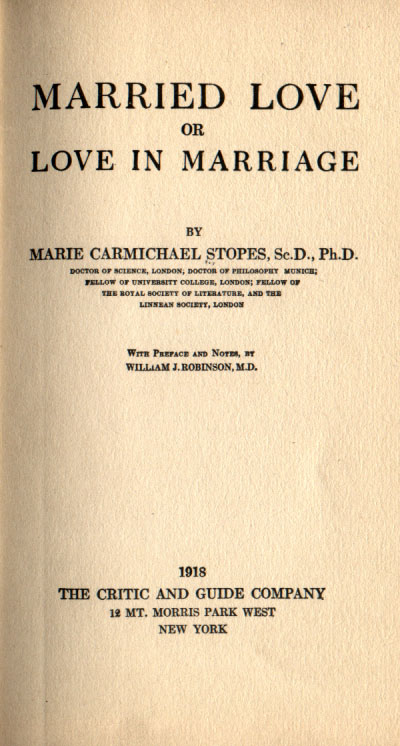
Marie Stopes wrote Married Love to “electrify England” and it succeeded in its task. By 1937 820,000 copies were sold worldwide. Her book was not the first or last manual on marriage and sex, but, as Hera Cook states, it transformed the discourse on heterosexual female sexuality and sexual practice. Stopes had no tradition to draw from to construct the ideology of an independent and emotionally active female sexual identity, which was formed separately from their reproductive capacity and from male’s sexuality. Creating a female sexual identity and role separate from reproduction was a major innovation. Before the development of effective contraceptives, nineteenth-century sex and marriage manual authors placed sexual activity alongside reproductive physiology reflecting a connection between sexual and reproductive roles for women. Birth-control was the crux of ‘married love’ which allowed pleasurable sex without hindrance of conception. Married Love was sparse in conveying details about birth-control because Stopes wanted to keep women’s sexual and reproductive roles separate. It was Wise Parenthood published later in the same year that provided the necessary details.
Married Love was unique in that the response Stopes received from women was phenomenal. Thirty-three respondents from the sample of letters studied wrote to Stopes to express their gratitude that finally someone seemed to understand not only the sex relations but the marriage relationship too: “it seems so wonderful to think that someone really knew love and understand as we do.” Married Love was written to promote equal and mutual enjoyment of sex which would provide a basis for a happy, successful marriage. Stopes noted that she knew that “in the middle classes in this country, marriage is far less happy than its surface appears” and it is no easy task to produce a successful marriage, especially when ignorance reigns causing despondency and ruptures in marriages all over England. Stopes established women’s sexuality and formed a sexual role for women within marriage, which was a departure from Victorian ideals that proposed women had no sexual feeling at all. Women in the past have been modelled to represent their husbands’ and society’s ideal wifely qualities:
"Woman’s side of the joint life has found little or no expression. Woman has been content to mould herself to the shape desired by man wherever possible."
The foundation of Stopes’ ideology in Married Love is that men and women are equal in marriage: “we are incomplete in ourselves; neither man nor woman can singularly know the joy of the performance of all the human functions”. Stopes argues that women should be treated as equal, intelligent and sexual beings. The notion that “sex-life is a low, physical, and degrading necessity which a pure woman is above enjoying” is completely rejected by Stopes as a “deeply rooted” social construction based on the idea that female ‘ignorance’ was really an indication of ‘innocence’ and ‘purity’, as one respondent highlights: “Parents, confusing “ignorance” with “innocence” are eternally threatening their daughters in the belief that ignorance combined with fear will safeguard their chastity.” Stopes argued that women were sexual creatures who had a right to satisfaction as well as men:
"Welling up in her are the wonderful tides, scented and enriched by
the myriad experiences of the human race from its ancient days of
leisure and flower-wreathed love-making, urging her to transports
and to self-expressions..."
Stopes showed that women could be sexual beings and it was above all natural. It was not depraved for women to want and enjoy sex.
Stopes argued that man has “used woman as his instrument so often regardless of her wishes” and he should alter his sexual technique to accommodate his wife’s needs. Even many feminists remained disinterested in questions related to female sexuality, which makes Stopes rather progressive in comparison to her contemporaries. Feminists’ main sexual issue was to emphasise a high moral code for women based on a belief in sexual control and chastity upon men. Stopes did adopt the idea that men should restrain themselves, as “it is his duty to do so, not only when his wife is ill, but also during menstruation and pregnancy”, but rejected other feminists’ endorsement of abstinence as women were sexual beings too and it would deprive women of the healthy benefits of sex. This revolutionises the perception of women in society from asexual acquiescent wife to an individual with sexual feelings parallel to a man. Stopes hoped the propagation of her ideology would diverge from the tradition of woman being used by her husband in the name of ‘marital rights’, which Stopes acknowledged that law and custom had strengthened. The husband had “the right to approach his wife whenever he wishes, and that she has no wishes and no fundamental needs in the matter at all.” Stopes combated this long-standing social construction with her Law of Periodicity of Recurrence of Desire in women. This law stated that women had ‘sex-tides’ and felt naturally more aroused at certain times of the month than others and the man was to use this tide to gauge his sexual approaches. The Law of Periodicity gave a biological mandate both to women’s rejection of a husband’s demands for sexual intercourse and to Stopes’ claim that women could desire sex for pleasure. It meant that women could desire sex at times determined by themselves and could ‘submit’ to their husband’s demands without being “lowered” but still maintaining the right to refuse on other occasions. This ultimately gave women the right to control the frequency and timing of sexual relations. Stopes argued that for the husband to enjoy the sex act and make his marriage a happy, contented relationship of harmony, companionship and love, he should always seduce his wife: “The supreme law for husbands is: Remember that each act of union must be tenderly wooed for and won, and that no union should ever take place unless the woman also desires it and is made physically ready for it.” Stopes explained that if a man disregards his wife’s wishes then “it is rape for the husband to insist on his marital rights” and subsequently he will make the act repugnant to her thereafter. This radical idea was increasingly adopted in the interwar period by feminists, but Stopes made it respectable by explaining that ‘married love’ and successful marriages depended on this equal negotiation between partners.
Married Love was unique in that the response Stopes received from women was phenomenal. Thirty-three respondents from the sample of letters studied wrote to Stopes to express their gratitude that finally someone seemed to understand not only the sex relations but the marriage relationship too: “it seems so wonderful to think that someone really knew love and understand as we do.” Married Love was written to promote equal and mutual enjoyment of sex which would provide a basis for a happy, successful marriage. Stopes noted that she knew that “in the middle classes in this country, marriage is far less happy than its surface appears” and it is no easy task to produce a successful marriage, especially when ignorance reigns causing despondency and ruptures in marriages all over England. Stopes established women’s sexuality and formed a sexual role for women within marriage, which was a departure from Victorian ideals that proposed women had no sexual feeling at all. Women in the past have been modelled to represent their husbands’ and society’s ideal wifely qualities:
"Woman’s side of the joint life has found little or no expression. Woman has been content to mould herself to the shape desired by man wherever possible."
The foundation of Stopes’ ideology in Married Love is that men and women are equal in marriage: “we are incomplete in ourselves; neither man nor woman can singularly know the joy of the performance of all the human functions”. Stopes argues that women should be treated as equal, intelligent and sexual beings. The notion that “sex-life is a low, physical, and degrading necessity which a pure woman is above enjoying” is completely rejected by Stopes as a “deeply rooted” social construction based on the idea that female ‘ignorance’ was really an indication of ‘innocence’ and ‘purity’, as one respondent highlights: “Parents, confusing “ignorance” with “innocence” are eternally threatening their daughters in the belief that ignorance combined with fear will safeguard their chastity.” Stopes argued that women were sexual creatures who had a right to satisfaction as well as men:
"Welling up in her are the wonderful tides, scented and enriched by
the myriad experiences of the human race from its ancient days of
leisure and flower-wreathed love-making, urging her to transports
and to self-expressions..."
Stopes showed that women could be sexual beings and it was above all natural. It was not depraved for women to want and enjoy sex.
Stopes argued that man has “used woman as his instrument so often regardless of her wishes” and he should alter his sexual technique to accommodate his wife’s needs. Even many feminists remained disinterested in questions related to female sexuality, which makes Stopes rather progressive in comparison to her contemporaries. Feminists’ main sexual issue was to emphasise a high moral code for women based on a belief in sexual control and chastity upon men. Stopes did adopt the idea that men should restrain themselves, as “it is his duty to do so, not only when his wife is ill, but also during menstruation and pregnancy”, but rejected other feminists’ endorsement of abstinence as women were sexual beings too and it would deprive women of the healthy benefits of sex. This revolutionises the perception of women in society from asexual acquiescent wife to an individual with sexual feelings parallel to a man. Stopes hoped the propagation of her ideology would diverge from the tradition of woman being used by her husband in the name of ‘marital rights’, which Stopes acknowledged that law and custom had strengthened. The husband had “the right to approach his wife whenever he wishes, and that she has no wishes and no fundamental needs in the matter at all.” Stopes combated this long-standing social construction with her Law of Periodicity of Recurrence of Desire in women. This law stated that women had ‘sex-tides’ and felt naturally more aroused at certain times of the month than others and the man was to use this tide to gauge his sexual approaches. The Law of Periodicity gave a biological mandate both to women’s rejection of a husband’s demands for sexual intercourse and to Stopes’ claim that women could desire sex for pleasure. It meant that women could desire sex at times determined by themselves and could ‘submit’ to their husband’s demands without being “lowered” but still maintaining the right to refuse on other occasions. This ultimately gave women the right to control the frequency and timing of sexual relations. Stopes argued that for the husband to enjoy the sex act and make his marriage a happy, contented relationship of harmony, companionship and love, he should always seduce his wife: “The supreme law for husbands is: Remember that each act of union must be tenderly wooed for and won, and that no union should ever take place unless the woman also desires it and is made physically ready for it.” Stopes explained that if a man disregards his wife’s wishes then “it is rape for the husband to insist on his marital rights” and subsequently he will make the act repugnant to her thereafter. This radical idea was increasingly adopted in the interwar period by feminists, but Stopes made it respectable by explaining that ‘married love’ and successful marriages depended on this equal negotiation between partners.
Stopes propagated the woman’s right to orgasm within the sexual relations of marriage. The removal of sexual intercourse from the notion that it was for procreation to the idea that it could and should be pleasurable for women was revolutionary. Women’s sexuality was now firmly established in its own right separately from that of the woman’s reproductive capacity. Stopes advocated “mutual adjustment”, which is “where the two are perfectly adjusted” and can reach a mutual orgasm. This equal share of enjoyment in sex is truly significant as women become equal to men in sexual relations. Stopes breached boundaries that had never been crossed by other sex and marriage manual authors before. She discussed the husband’s inability to abstain the moment of orgasm until his wife was ready: “the man’s climax comes so swiftly that the woman’s reactions are not nearly ready. And she is left without it.” Stopes severely criticised coitus interruptus because it meant that women were left “in ‘mid-air’” and therefore unsatisfied. Although men get the complete sex-act through coitus interruptus, it deprives women of the man’s secretions, which Stopes claimed were beneficial to a woman’s health. To stop this Stopes stressed the idea that men should alter their sexual technique to increase female sexual pleasure focusing on foreplay and prolonged intercourse enabling women to have the benefit of an orgasm without the concern of becoming pregnant because the married couple would be practicing birth-control.
F.Y.I: This is copyrighted ©
Tuesday, 29 July 2008
A Fan or Foe?: Emily Dickinson on Marriage

Old Fogey and I had a bit of a debate about Emily Dickinson a while back about her attitude to marriage (see here). Her feelings towards marriage vary from poem to poem offering a controversial and a confusing narrative, which means it is difficult for the reader to get a definitive answer on whether she was a fan or a foe of marriage. Dickinson's "I'm 'Wife'" poem, which sparked the debate has already been discussed, so check out the OF's blog on it! Needless to say it seems this poem portrays Emily as unfavorable to the idea of marriage, that it confines women to a title, but she also intimates that after girlhood, what else is there for a woman but marriage? OF believes behind this bitterness there is an element of accommodation, that she would not have minded being married
Now, to further Emily Dickinson's confusing narrative further on the state of marriage I will look at a few of her other poem...
So to commence: -
Wild nights! Wild nights!
Were I with thee,
Wild nights should be
Our luxury!
Futile the winds
To a heart in port,
Done with the compass,
Done with the chart.
Rowing in Eden!
Ah! the sea!
Might I but moor
To-night in thee!
So to commence: -
Wild nights! Wild nights!
Were I with thee,
Wild nights should be
Our luxury!
Futile the winds
To a heart in port,
Done with the compass,
Done with the chart.
Rowing in Eden!
Ah! the sea!
Might I but moor
To-night in thee!
This I think has more to do with love, passion and sex rather than marriage, despite it rarely being distinguished separately in Emily's era from marriage. For a woman to describe these sentiments is not unique but definitely rebellious!
This poem, an extended metaphor of sex, is relatively easy to get to grips with. "Might I but moor//To-night in thee!" cannot be mistaken for anything that talking about carnal knowledge. Still, I think the shortness of it shows passion, and of course it is Dickinson's passion. The short outburst of longing for it shows a regret of a sort. Dickinson's 'feminist' stance, so often against marriage, here shows that she is not against men or about the 'luxury' of love. In fact she is rather for love, shown by her mimicking Keats and the themes of Romanticism in "I died for Beauty-but was scarce".
I think for Dickinson marriage was not desirable, but the idea of love she seems to regret more than anything in her poetry.
In her poem "How many times have these low feet staggered-" the image of the "Indolent Housewife" dying in a state of drudgery does not show the role of women as housewives positively and in turn sneers at marriage for confinign women to this role.
How many times have these low feet staggered-
Only the soldered mouth can tell-
Try- can you stir the awful rivet-
Try- can you lift the hasps of steel!
Stroke the cool forehead- hot so often-
Lift- if you care- the listless hair-
Handle the adamantine fingers
Never a thimble- more- shall wear-
Buzz the dull flies- on the chamber window-
Brave- shins the sun through the freckled pane-
Fearless- the cobweb swings from the ceiling-
Indolent Housewife- in Daisies- lain!
I love the imagery of this poem- the typical imagery of sewing to define a domestic setting and housewifery: "Never a thimble-more-shall wear-". The creepiest image Dickinson uses throughout her poetry is the fly (or flies) in this case. They seem to represent death (see "I heard a fly buzz- when I died"). Here they also help to show the house as falling in disrepair after the death of the housewife- the flies at the window, the window dirty or "freckled" and the cobwebs boldly dangling from the ceiling. It almost shows the limits of her work but also that the man won't or can't do the work she did.
He put the Belt around my life-
I heard the Buckle snap-
And turned away, imperial,
My Lifetime folding up-
Deliberate, as a Duke would do
A Kingdom's Title Deed-
Henceforth, a Dedicated sort-
A Member of the Cloud.
Yet not too far to come at call-
And do the little Toils
That make the Circuit of the Rest-
And deal occasional smiles
To lives that stoop to notice mine-
And kindly ask it in-
Whose invitation, know you not?
For whom I must decline?
This triples up almost on themes; it encompasses marriage, class and also possibly a commitment to God. In the case of the first and last idea, patriarchs at the helm controlling what the woman should do. It is ending the woman's life : "My Lifetime folding up-" by marrying for a "Kingdom's Title Deed" and also for religious reasons her life would fold up, the "Kingdom's Title Deed" being instead for heaven rather than actual material wealth. The sharp violent sound of snap on the second line after "He put the Belt around my life" is jolting and draws attention to the woman being controlled, inferior and unable to escape. I prefer the primary idea that thios poem is more to do with marriage than religion, though a dual meaning is rather more likely.
The "He", the first word, the condemning word illustrates where the blame lies, who is being discussed and sets the tone for the rest of the poem. The woman must meekly follow his lead and do as her social status requires ("make the Circuit of the Rest").
Another more disturbing poem Emily Dickinson penned was: -
He fumbles at your Soul
As Players at the keys
Before they drop full music on-
He stuns you by degrees-
Prepares your brittle nature
For the Ethereal Blow
By fainter Hammers-further heard-
Then nearer- Then so slow
Your Breath has time to straighten-
Your Brain- to bubble Cool-
Deals- One- imperial- Thunderbolt-
That scalps your naked Soul-
When Winds take Forests in their Paws-
The Universe- is still-
This poem is again about sex, but I think this time it definitely more violent than the soft passionate lulling of the sea imagery in "Wild Nights! Wild Nights!" This poem is about rape crafted by the aggressive vocabulary selected: "fumbles", "Drop", "stun", "Ethereal Blow", "scalps" and also the line "Deals-One-imperial-Thunderbolt-". The dashes aid the dramatic effect and adds to rather unpleasant reading I think. Again this poem starts with a "He" and deliberately shows the culprit: of course, a man. In this case I am unsure whether it is a husband, but it seems likely. It was typical for this 'without love sex' to be considered within marriage. "Wild Nights!" mentions no "He" in the poem. It infers that a man is present to be "moored" in her harbour, but the lack of presence of a gender allows Dickinson to praise passion, romance and love of its own accord rather than marriage and the conjugal duties accorded to the husband.
So, to conclude... Emily Dickinson is a fan of love and passion but a foe of marriage. Her circumastances in her own life had obviously made her bitter but at a time when she was socially graded by her status, married or unmarried, she would have felt keenly that she had no role in society. Unlike today where women can have a role within and without marriage shows how time has changed. It also makes it hard for us to understand Emily, but essentially we can summise that Emily missed to closeness and happiness love and romance gave but was not sorry to be unmarried. Marriage, she thought, would not allow her to conceive of her passionate ideals of love. Whether she was right, I am unsure, but she penned some fabulous poetry!
Subscribe to:
Posts (Atom)