“I will be canonised in 200 years time”, scribbled Marie Stopes in a margin of a Catholic pamphlet. Marie Stopes, undoubtedly, was her own biggest fan, but the public hype she built around herself and her work, although exaggerated at times, was essentially well-earned. She had transformed society, but to what scale? Her publicising and popularising of sexual equality in marriage, birth-control and voluntary motherhood combined with her class prejudiced, eugenicist jargon that infiltrated all her ideology made her both a much loved and hated figure. One cannot deny that her books, articles and clinics caused a stir, which opened up the separate spheres of men and women so they could communicate to find an effective solution for fertility limitation and a better marriage. Sexual knowledge and birth-control had been things strictly limited to males and ‘lewd’ women, whilst female sexuality was something that had never been contemplated separately, or indeed seriously, from women’s ability to procreate. Stopes produced a remarkable ideology that, if not practiced, surely opened social and cultural barriers in society to allow the free dissemination and discussion of such ideas.
Stopes’ ideology was rather contradictory. In some ways it was revolutionary in that it promoted female liberty and sexual pleasure in marriage, but it was still conservative advocating only heterosexuality and marriage. Her notion of sexual equality did not extend to include the idea that women could dominate sexual relations. However, Stopes idea of equality within marriage no longer allowed women to be sidelined as the weaker sex. Stopes was particularly revolutionary in comparison to many of her feminist contemporaries. Although Stopes agreed with feminists that marriage should not give the husband ‘conjugal rights’, she rejected the idea that women were passionless. Stopes depicted women as sexual beings and introduced her theory of the ‘Law of Periodicity’, which gave them the right to refuse or accept their husband’s sexual advances without been seen as “frigid” or “depraved”. Husbands wrote to Stopes to ask for advice on how to control their erection, for example, so they could satisfy their wives. These men were actively trying to implement Stopes’ idea of equality and mutuality within marriage, which transformed the marital relationship. However, Stopes’ marriage manuals were aimed mainly at the middle-classes. While some of the ideas may have diffused into the working-classes, the absence of such female rights in cheaper pamphlets like A Letter to Working Mothers indicates that such ideas were meant only for the ‘respectable’ classes. Stopes was not as revolutionary as she could have been, but her policies were radical for the time, which had a definite impact on middle-class women.
Stopes succeeded somewhat in dispelling the ignorance of those women who had come into contact with her through her newspaper articles, her books or her clinics. She disseminated sex and birth-control information in a time when doctors were unable or unwilling to provide their patients with such information. Accessibility and availability was one of the problems Stopes tried to overcome. Setting up a mail-order service from her London Mothers’ Clinic and ensuring her name was constantly in the press, she guaranteed that the majority of society at least knew who she was and what she was fighting for. When knowledge on some topics were limited and highlighted by individuals in their correspondence, Stopes reacted, sometimes publishing another edition of her books to include the missing information. The accessibility of such information reduced sexual ignorance as well as empowering women with the knowledge of how to control their fertility. Although Stopes’ message reached the working-classes, few of her recommended methods were adopted. Middle class women were able to adopt her methods because they had the money to spend on her Racial Cap. They were more receptive to change, unlike working-class women.
Stopes had to overcome the social and cultural barriers of the working-classes, but her middle-class status combined with her own ignorance meant that she did not understand their needs and problems the working class people faced. Although she did recognise on some level that she had not succeeded to have an impact on working-class women, she failed to alter her strategies to overcome the social and cultural barriers, which would have enabled more women (especially the working-class women) to use her recommended artificial and reliable contraceptive methods rather than abstinence and withdrawal. Despite the class differentiation on the practical application of contraceptives, the knowledge of birth-control was made open and available to all classes.
Her aims: a superior race and happy, healthy mothers and children, were intertwined and inseparable. Although it is impossible to distinguish her motives behind her promotion of birth-control, we know that Stopes gave women of all classes some amount of knowledge to help end numerous childbirths that resulted in needless waste of life of the child and mother. Whether eugenicist principles or feminist principles were behind it is secondary to the effect Stopes had on infant mortality and society’s awareness of it. All women were helped and no woman was spared from Stopes’ eugenicist ideal. According to her working-class women were degenerating the race and middle-class women, the good stock, were expected to have more children that were fit and strong to create a good, healthy race. To some degree, Stopes was successful in creating a better ‘race’ through her propagation of happy and healthy families. The combination of equality in marriages, voluntary motherhood through birth-control and sexual knowledge gave rise to the understanding of female sexuality and the knowledge of how to use birth-control effectively.
Stopes had constructed a complex ideology, which based each notion on the following... To have a successful marriage, Stopes argued that the mutual orgasm was the solution. To ensure women could enjoy sex without the fear of pregnancy, birth-control would have to be used. Birth-control was the double-edged sword, as it was central to Stopes’ ‘constructive’ eugenicist ideology as well as protecting women from numerous pregnancies. Culmination of which is a successful marriage. All of Stopes’ ideas were combined and indistinguishable from each other. It was an exceptional and very progressive ideology, but it was inherently flawed.
The reason Stopes was unsuccessful in revolutionising society was because she did not propagate her idea of equality in marriage and female sexuality to the working-classes, which meant that they could not follow Stopes’ ideology as she had envisioned. No doubt the indistinguishable nature of her feminist and her eugenicist motives made many working-class women wary of adopting her ideology in case they were allowing themselves to be manipulated to her eugenicist interests. Alas the working-classes needed revolutionising the most. The middle-classes had already limited their fertility and women had gained the vote. The feminist movement was mainly a middle-class phenomenon and women were expanding their sphere of influence of which Marie Stopes herself was a living example. Essentially, the working-classes were excluded from this ‘social revolution’.
The overall conclusion is that Stopes was a social reformer, not a revolutionary. She helped women, but not uniformly. Class differentiation meant that Stopes led a piecemeal revolution that generally excluded working-class women. She remained rather conservative in some of her aims, but she provoked controversy with her policies. Her ideology set middle-class women on the long road to a sexual revolution, which working-class women would join later.
Tuesday, 20 January 2009


I have forgotten one of my resolutions already...
On flicking back through my posts recently, I realised that I had not stuck to my NEW YEAR'S RESOLUTION to learn something new. So here it goes. Instead of things I have learnt each day, here are twenty things (to represent 20days) I have learnt recently...
1) On sibling rivalry: This is not restricted or limited to me and my brother. It is nice to know that although you get on so well, you can still bicker and get annoyed with them and it is ok, and you can still be friends. AND you don't need to know everything about them. Something i always feel very guilty about. I needn't, but I perhaps should make a more concerted effort.
2) I learnt how to parallel park and not mount the curb.
3) Masters are bloody hard to apply for and have far too much paperwork. But on the other hand, if it is worth doing, it is worth taking the time over.
4) That my ex-lecturer is pregnant and still remembers me (I asked her for a reference for my Masters!)
5) That Thomas Wolsey, later Cardinal Wolsey in Henry VIII's time, built Hampton Court and gave it to Henry as a gift. Nice gesture.
6) Henry VIII was married to Anne Boleyn for 3years. I thought it was longer. Apparently she pissed him off sooner than I imagined...
7) For more Henry related facts: Catherine Parr was only married to him for a year as an intellectual companion and a year after she married him, he died and a year later after marrying John Seymour (I think it was) who was said to be the love of her life, died.
8) The Alexander Technique= ??? still a mystery but I learnt it :)
9) I am still emotionally available apparently! I thought I was going to remain celibate forever, but I think I may have found my lust again! YAY! This is good news by the way folks haha! I thought I was cold and lofty. Now I know how nuns live, I know I can survive... I feel a rendition of "I will survive" right about now!
10) I can emergency evacuate a disabled person down stairs now using a fancy chair thing.
11) Essex University's History Department is apparently second in the nation in its historical research! haha! And I learnt there! Up yours posh places.... Not that I am bitter!
12) Charles Dickens had a secret mistress and she lived in Slough for a short while.
13) On a similar note, Slough has a record office... I see work experience/future employment there??? Possibilities...
14) That spiders been given LSD make more symmetrical and better webs than those on caffeine, the human world's biggest drug, used daily. What does that say about our daily work? Go QI!
15) On a similar note on the creature world... let's call it our creature feature... snakes don't respond to the music snake charmers make, but the snake charmer's body actions. Although snakes do have the ability to hear (despite popular belief), they are not charmed by this music.
16) I did not realise the song from Moulin Rouge *one of my all time favourites* called The Show Must Go On was by Queen. I should have known since all the songs from Moulin Rouge are spoof-like/rougey-copies of very popular songs such as Smells Like Teen Spirit by Nivana and various Beatles songs *shakes head in shame*. But on the plus side, I was very excited on hearing it at the theatre on seeing "We Will Rock You"!! I was singing along a lot! :) And now has surpassed the Moulin Rouge version for me!!
17) And subsequently, I did not know that Freddie Mercury was called Farrokh Bulsara originally and came from Zanzibar, his parents originally from British India. So there we go... Queen suffering somewhat from overkill in our house at the moment through the greatness of firstly their music of course, and also the hit west end show- aMAzing!! In the words of Craig Revel Horwood or whatever his name is off Strictly Come Dancing!
18) That the Disney film, The Sword In The Stone, was actually a book. Well, I think I did, because i found it on a list I made of books to read *oh yes I am that cool*. Well, I found it in my Oxfam bookshop and have read it. It is BLOODY BRILLIANT!! It is better than the film *of course* and its anachronistically funny, has historically references to the time it was written eg. comments like "the bloody reds" "the Bolsheviks" etc! Great, great!! Merlyn is an ace character to and really shows human interaction of Wart the young boy, with Kay (an older brother-like figure and semi-bully). The J K Rowling of the early 20th century!
19) Entspann Dich = Relax (I am trying to pick up a little German, most of which I have seemed to forgotten in fours years...) Auf bitchen- to get tarted up for a party apparently...
20) Redest du mit mir? What are you looking at?
Mach den kopf zu! = Shut up.... not quite as short and sharp as English...
Wednesday, 7 January 2009
The Story of Susanna


 The story of Susanna is told in the Apocryphal Book of Daniel and Susanna.
(As an aside, "Apocryphal" books of the Bible, which are received by some Christians as an authentic part of the Holy Scriptures, but are rejected by others. There are 14 such books, formed part of the Septuagint. The Council of Trent included all but three in the canon. The German and English Reformers grouped them in their Bibles under the title Apocrypha, as not having dogmatic authority, but being profitable for instruction. The Apocrypha is now commonly omitted from the King James Bible and most other English versions of Scripture.)
Susanna was brought up by religious parents, married Joakim- a rich man of Babylon at whose house the Jewish elders met and where they held their trials. Joakin had a walled garden at this house and it was to this garden that his beautiful wife would resort when the elders came. Two of the judges became obsessed with Susanna because of her beauty and lusted after her. Although they were too ashamed to admit their feelings, one day they each snook into Joakim's house to spy on Susanna and discovered their mutual lust. Resolving to seek an opportunate time, they kept a close eye on Susanna and waited for a chance to catch her alone.
One very hot day, Susanna and her two maids went into the garden and Susanna decided to take a bath. She sent her two maids out for soap and olive oil and bade them to lock the gates until their return. The two elders, who were already inside the garden, ran up and demanded that Susanna yield to them: "'If you refuse, we shall give evidence against you that there was a young man with you and that was why you sent your maids away.'
Susanna groaned. 'I see no way out. If I do this thing the penalty is death; if I do not, you will have me at your mercy. My choice is made: I will not do it. It is better to be at your mercy than to sin against the Lord'"
The elders promptly shouted down her cries for help and accused her, shocking everyone, for her reputation was spotless. The two elders proclaimed their story and demanded her death. The people believed the judges and assented to her death, but as she was being led away, affirming her innocence and appealing to God.
Daniel, young though he was, was inspired by the Lord to come to Susanna's aid. The rest of the elders accept his authority, seeing that 'God has given you the standing of an elder', and Daniel proceeded to have the elders separated and questioned them about the details of their story. When they disagree, he proclaimed their crime and the people turned upon them and they were stoned to death according to the law of Moses.
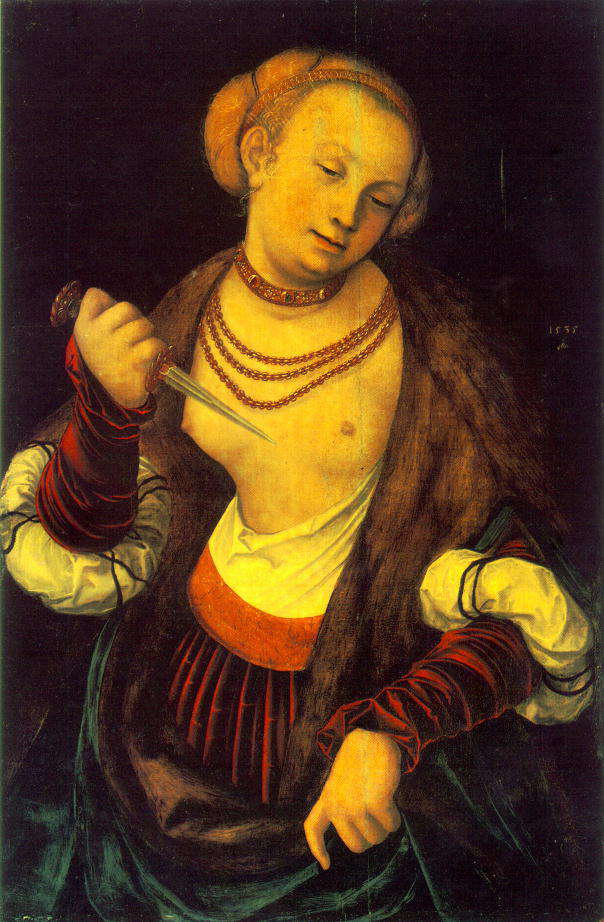
The story gives a chance for artists to show the Susanna's faith and her trust that God will save her, the depravity of those who wold use the law for their own personal profit, and perhaps also to draw a comparison between Susanna and Lucretia who, in a similar situation, did not resist in the face of Tarquin's threat to kill her and a servant and tell everyone that she was taken in the act of adultery, leaving no one alive to tell her story and prevent her reputation and that of her husband from being stained.
(NB. The painting of Lucretia by Lucas Cranach the Elder is amazing and should be checked out. It also shows that the story of Lucretia and the story of Susanna were simultaneously going through a popular spurt in art in the Renaissance and Baroque period, although earlier depictions can be found.)
Without a doubt, the artists were more than happy to explore the theme of Susanna (and Lucretia) because of the possibilities it offered for a prominent nude female within the painting itself, particularly the bathing scene. What can I say but pervy men, eh? heehee
But seriously check out some of the picture above and see for yourself the artisty involved in just one story.
As another aside to this rather random blog, I have come to love these 'stories', as I shall call them, concerning women and how they upheld their virtue for their husbands, for society and most importantly (often) for God. This says a lot about the time and society in which these pieces of art were painted. Thank you Classical Civilisation A-Level...
(Ok, the uploading pictures seems to be malfunctioning at the moment! I will keep trying though! See here for the early art on Susanna and here for another collection. Hopefully tomorrow this function will be back up and running!!)
All That I Owe the Fellows of the Grave
All that I owe the fellows of the grave
And all the dead bequeathed from pale estates
Lies in the fortuned bone, the flask of blood,
Like senna stirs along the ravaged roots.
O all I owe is all the flesh inherits,
My fathers' loves that pull upon my nerves,
My sisters tears that sing upon my head
My brothers' blood that salts my open wounds
Heir to the scalding veins that hold love's drop,
My fallen filled, that had the hint of death,
Heir to the telling senses that alone
Acquaint the flesh with a remembered itch,
I round this heritage as rounds the sun
His winy sky, and , as the candles moon,
Cast light upon my weather. I am heir
To women who have twisted their last smile,
To children who were suckled on a plague,
To young adorers dying on a kiss.
All such disease I doctor in my blood,
And all such love's a shrub sown in the breath.
Then look, my eyes, upon this bonehead fortune
And browse upon the postures of the dead;
All night and day I eye the ragged globe
Through periscopes rightsighted from the grave;
All night and day I wander in these same
Wax clothes that wax upon the ageing ribs;
All night my fortune slumbers in its sheet.
Then look, my heart, upon the scarlet trove,
And look, my grain, upon the falling wheat;
All night my fortune slumbers in its sheet.
Ever since I have watched The Edge of Love about Dylan Thomas' life during the Second World War I have since dug out my book of wee Welsh poems! In it I stumbled across All That I Owe The Fellows Of The Grave. It struck me today because after reading Jenah's blog here I am fully disillusioned with the world. Ok, ok, I was probably really disillusioned before, but I did come to realise this by reading this poem last night before work with a glass of (I would like to say wine but I was a classy bird and drunk a glass of...) Lambrini (leftover Christmas goods- it would lose its fizz if I didn't drink it!) He wrote this- what? Seventy years ago about a war that was "for good" to get rid of the "bad". Whether that war was right/wrong, necessary or not I am not venturing into. A lot of live lost, but with this thing going on in the Gaza strip... well, what can say? What has changed? How have we as human beings changed?
This poem I imagine in my head is how those families of the three little boys who had died and the sisters, and all the people killed in this mess feel... but I wonder when all those who have committed crimes will ever feel like this?
And almost as a post-script today I heard a little story from one of my colleagues who takes groups of visitors on tours. He took a group of Americans from the state of Georgia when 'prompted' by my colleague's comment of how our state works i.e. monarchy and parliament rather than a presidency as par of the tour, they made a solemn promise to him that they would kill the recently-elected-soon-to-be President Obama within six months. My colleague exclaimed he did not know what to say! He looked like he was munching on lemons from what I could tell. Again, the disillusionment I felt was staggering. In this age of 'liberalism', 'freedom' and 'modernity' we still uphold in some places in the world bigotry, stasis and evil. Exclamations of "gee you have them here too", to which the majority of us would say "Who?" I guess we can already guess the answer would be "n*****s", but the shock is not any the less. How much has this world changed? Really?
Answer: In many ways, lots, but in the fundamental ways we still ahve a long way to go, which the past week's news bulletins show. Disillusionment, sadness and pessimism summarise my feelings today.
Thursday, 1 January 2009
Top Ten Films of the Season That Aren't Seasonal...


These are some of the best films that I have seen recently, some for the first time, others for the millionth time, some new, some not so new!!
1) Mamma Mia
After dragging my brother to the cinema to see this and embarrassing him horribly with my loud, amazingly out of tune voice and dance moves, I find it almost needless to say that I loved it! I was working with two other ladies today, who both received this film for Christmas too and we were having a bit of a sing song at work which was nice... and breaks up the monotony of working on New Year's Day (which is appeased also by the gorgeous smell of beef wafting up the stairs at home and me now in bed with my pjs on listening to the repeated DVD menu soundtrack of The Edge of Love!!)
I feel another urge for Mamma Mia to be put on for that ultimate feel-good factor. You may not be able to bottle it, but you sure can put it on a DVD!!
2) Wilde
Having already mentioned a bit about this film before, I shan't say too much except that Stephen Fry is an absolute legend and it is has spurred me on to read Oscar Wilde which I am ashamed to say I have never read before. I have just read Lady Windermere's Fan!! haha i loved it- It is really very easy to read and because it is a play you flick through it and it moves very fast! (gawd, I love my xmas presents this year!!)
3) Blood Diamond
I have also mentioned this film before. Although I wasn't entirely sure I was convinced by Leonardo DiCaprio's accent (I am naff on really knowing whether an accent is right, except for American/English, and especially when it is supposed to be British and it is clearly very American... anyway I am deviating...)
This film is dark, sad and pessimistic, but it is rivetting and really opens up one's eyes, whether it is entirely factual or not... Human nature is seen at its worst and at its best in this film. Based in Sierra Leone and set during their dreadful Civil War something, which if you hadn't been alive or old enough to understand at the time, has now missed the younger generation's notice. It was truly educational as Hollywood gets. Great movie though... drama, love, violence, action, etc... great film...
4) The Dark Knight
I have succumbed the greatness of this film. My brother got it for his brithday in the end and I was astounded. Excellent performance by Heath Ledger as everyone has commneted but the plot of how far can you push the law, how moral is it to do this, that or the other... is it worth it to stop crime? The morality and psychology of it was compelling and of course, with the late Heath in it... just watch it!
5) Under the Tuscan Sun
A daft RomCom that I bought my mam for Crimbo- we had seen adverts for it and said we should see it... It is about a woman who's marriage falls apart and goes randomly on a gay trip of Tuscany, buys a villa and learns how to live her life. It just shows that life will work out eventually but not always in the way you expect. You will find what you wanted does come to you, but in a different way tha how you thought. Just a nice exotic film, which slightly reminded me of A Room With A View in the sense that you have to mature and live life... Lucy certainly learnt to do so in Italy (in RWV).
6) The Edge of Love
Beautifully shot, set in London/Wales during the Second World War starring Keira Knightley and Sienna Miller in, it is based on Dylan Thomas, the Welsh poet, broadcaster and short story writer's life. Although it was "too dark" for my mam's tastes, I really enjoyed it. How it is shot though is lovely... cliched as it may sound breathtaking at times...
7) Goodnight Mister Tom
Classic!! Enough said! Read it then watch it! You will cry everytime!!
8) Chocolat
Johnny Depp. Again probably enough said (!), but I will elaborate. Based on Joanne Harris's book of the same name this film does what the book doesn't do for me. Resolve. All the way through the book and the film, Vivien is trying to resolve her life through resolving other's misfortunes (with chocolate I may add!) as has been her family's calling for generations. In the book, she scuttles off with the North Wind, never finding that inner peace and sense of belonging that she had hoped for, but in the film she does find it and stays in this once-bigoted-now-suddenly-liberated village through her chocolate. Good film, not so great book. Another book to join the "Charlotte Gray" list (see for analysis my blog here, where the film is way better than the book!!)
9) The Departed
Good modern gangster/police film!! Leonardo DiCaprio again as an Irish American acting as a spy for the police in the Mafia. Matt Damon also stars as the gangster disguised as a cop to be a spy for them!! Genius plotting and a great ending, though very shocking and abrupt!! Not for the faint hearted!!
10) August Rush
A sweet family film with some wicked music included. It is about a young boy who doesn't know his parents and ends up busking with Robin Williams (a role model, albeit a bad one) to earn money. He has an amazing natural ability to play instruments and understand music and he is doing it to find his parents. A bit twee I will grant ya, but I watched it and fell in love with it! The guitar solos (ok, done by an amazing adult guitarist in real life) are awesome! The kid who played Charlie in the most recent Charlie and the Chocolate Factory is August Rush, and the hottie who plays a very unrealistic looking Henry VIII in The Tudors is his dad! yum... probably one for the girls... but my brother was the one who was watching it when i sat dow to watch it... but this is from the guy who got me hooked on High School Musical!! haha... gawd bless him for that! Summary of August Rush: Cheese balls covered in cheese on a cheese stick!
Happy 2009!
I guess I ought to do something as cliched as to make resolutions. I do tend to stick to them, which is probably why I do not make them!
1) My first resolution of 2009 is to lose weight. Despite my endless talk of "I should go on a diet" etc I never do. I don't really believe in diets. I eat healthily enough, I just need to moderate the portions and exercise more.
2) Second resolution: To pass my driving test. Definitely easier said than done. Ask the 15 year old cyclist for a reference on this point.
3) Do my Masters. :)
4) Learn something new everyday and keep a diary of it.
5) To just be me, not let anyone boos me around or feel inferior... and to stop moaning. I have got a lot going for me at the moment. What more can I want? I am young, I have a job, I have a roof over my head, I have no terminal disease, I have food, I don;t have to walk twenty miles to collect dirty drinking water, have bombs falling on my head, etc etc... I included a lot i this one, because it is more about my outlook on life rather than separate things...
Yeah, so I will let you know how that is progressing!! haha...
Friday, 19 December 2008
Favourite Famous Quotes I: Facebook ones...
I take life with a pinch of salt, a wedge of lime, and a shot of tequila.
(Now this is from a magnet I got after my first year of Uni and it really applied to how I take things in life! I really do take a shot and hope for the best in the end... alcoholics anonymous here I come!! I am sure I will be in Rehab with Amy Winehouse anyday soon!! LOL)
All great things are simple, and many can be expressed in simple words: freedom, justice, honour, duty, mercy, hope. (Winston Churchill)
(Great man! And a very true quote. What would happen if every single one of us did this? If we were all merciful, hopeful and fair where would the world be? And if we all promoted honour and duty, would there be any yobbos on the street? I dunno, sometimes I wonder what Winston would have made of this world... and btw, I dont think he is by any means totally innocent. He could have been reminded of this speech at the Nuremburg trials... Why did the English, American, Russian and French never go on trial themselves?)
Although prepared for martyrdom, I preferred that it be postponed. (Winston Churchill)
(This quote made me LMAO (laugh my arse off!!) I would like t be remembered for something good, but you know... not RIGHT now!!)
History will be kind to me for I intend to write it (Winston Churchill)
(Oh so true!! I am gonna be there writing it... go me, wee historian!! Go, Gal!! Go!!)
Anyone who lives within their means suffers from a lack of imagination. (Oscar Wilde)
(This just makes me wonder... I live within my means... and i am seeking inspiration to spend it!! haha!! I like the idea, that if you can't take this money with you then you might as well do something exciting with it!!)
Mortality, like art, means drawing a line someplace (OW)
Oscar Wilde was a very wise man. This quote almost makes dying art in itself. Death is afterall just drawing a line underneath line. Hopefully there will be more afterwards!
Always forgive your enemies; nothing annoys them so much (OW)
(Btw this works, I have done it... they never live it down, even after you are friends years afterwards. They never understand why and it gives you a good feeling!)
Freedom is not worth having if it does not include the freedom to make mistakes (Ghandi)
(I have made many mistakes, and I have learnt a lot from them. It also means we can come to see other's errors and realise they are no less or more than us. It is equalising!)
An eye for an eye makes the world blind (gandhi)
(Heard this in a film before I realised this was said by Ghandi... Revenge really doesnt solve anything... see above!!)
"I'm just a fucked up girl looking for my own piece of mind" Clementine Kruczynski (Eternal Sunshine of the Spotless mind)
(I am a fucked up girl and I am looking for my own piece of mind... solved? oh God no... see my blog!!)
How happy is the blameless Vestal's lot! / The world forgetting, by the world forgot / Eternal sunshine of the spotless mind! / Each pray'r accepted, and each wish resign'd.
(see my first ever blog...)
You find a glimmer of happiness in this world, theres always someone who wants to destroy it. (Finding Netherland)
(I love Johnny Depp and Kate Winslet in this movie, but this quote is so right. I work at a place where relationships with children are confiner by what we can and cannot do. We can't even hold thier hands if they are lost. What the world has come to, I do not know, but it is true... you do something pure, honest and good, and there will be one person to think it is wrong!)
I am a nice shark. Not a mindless eating machine. If i am to change this image, i must first change myself. Fish are friends, not food!
- Bruce (Finding Nemo)
GREAT QUOTE!!!
"You seen my girlfriend, tall, thin, legs for days?"
"Yeah. I pitched her overboard." (Center Stage)
*AGAIN HUMOROUS WITHIN THE CONTENT!! DAMN BALLET DANCERS!!)
The next man that laughs is gonna get his head ventilated.
- Bill Hickok (Calamity Jane)
When a man gets tired of London, he is tired of life (Dr. Johnson)
Thought the harder, heart the keener (ESEEX UNIVERSITY MOTTO)
"If his unpleasant wounding has in some way enlightened the rest of you as to the grim finish below the glossy veneer of criminal life and inspired you to change your ways, then his injuries carry with it an inherent nobility and supreme glory. We should all be so fortunate. You say poor Toby; I say poor us." Sphinx
"He spoke." Tumbler
"Hey man, I thought you were from Long Beach." Memphis (Gone in 60 seconds)
"Nobody is as mysterious as they think they are" Claire Colburn (Elizabethtown)
"It takes a great deal of courage to stand up to your enemies, but a great deal more to stand up to your friends" Dumbledore (VERY TRUE! :s)
"Thoughts could leave deeper scarring than almost anything else" madam pomfrey
How much easier it is to be critical than correct. -Disraeli (REMEMBER THIS WHEN CRITICISING OTHERS....)
We make a living my what we get, we make a life by what we give. (Churchill) A MOTTO TO LIVE LIFE BY I THINK. IF WE ALL LIVED BY WHAT WE GAVE, WE WOULD ALL BE IN POVERTY...
Politics is war without bloodshed while war is politics with bloodshed. (Mao Tse Tung) TO BE HONEST THOUGH I CONCEDE BOTH ARE SOMETIMES NECESSARY, I DON'T LIKE EITHER.
"In vain I have struggled. It will not do. My feelings will not be repressed. You must allow me to tell you how ardently I admire and love you." Mr Darcy (BEST NOVEL EVER- JOINT WITH PERSUASION- ROCK ON JANE AUSTEN!!)
"Can't you tell me off the record?"
"Off the record, I like to be kissed before I am fucked." (Blood Diamond)
GREAT QUOTE. THIS FILM IS ACE!! SEE IT!! SOUTH AFRICA/GREED/MONEY/CORRUPT/HOT LEONARDO DICAPRIO WHAT ELSE CAN YOU ASK FOR... ALSO- SEE THE DEPARTED!! WITH MATT DAMON IN WITH LEO!!
Tuesday, 16 December 2008
MUSE (favourite band of all time!), HYSTERIA!

HERE is one of my all time favourite songs by one of my all time favourite bands! Got me through some tricky times, but Oh God! Can they play their instruments! And Matt Bellamy was self-taught (vocalist, pianist and guitarist!) so woohoo! Go him, and went to school not too far from where my Grandparents now live! They were in the local paper when I was last down there and I was very excited, and so was my Grandad who was surprised to find a band I liked were in actual fact famous and were also from Devonshire!! Like the two couldn't be mutually exclusive!! haha!! Anyways, good song...
I really need to find out how you pop the youtube window in the blog....
***ROCK OUT LIL SOLDIERS!!***
Country House Rescue


Howdy folks!!
I was just having a quiet evening before the week of traditional Christmas overindulgence, and I was watching this programme on Channel 4 'Country House Rescue'. Now then, I love this lady who goes in here and pulls these little posh oiks, who have the self-discipline, common sense (ok granted I am not well-endowed in this myself!) and hedonistic attitude. Now this guy who has recently inherited Elmore Court in the Cotswolds, one Anselm Guise, with a family tree as long and as old as the establishment of England itself! Ruth Watson, this posh but rather surprisingly profanity-issuer, advises this 30-year-old-something DJ how to "diversify and raise revenue to secure his future". I got the impression that his parents had left him to sort it out himself in the hope it might make him grow up and take on some serious responsibility! I guess it worked, he set up a cookery school within his house complete with accommodation in the grand Tudor rooms. He pulled his socks up and made it a success.
It just made me glad to see these half-aristicratic heirs to historical heirlooms can a) take over the history and commitment the house needed and b) also showed the upper class brats being pulled up by their boot straps rather than just working class/middle class kids with programmes such as Lad's Army etc, etc, etc!
Very good programme though- plus some seriously nice old stuff!! haha technical term that for us historians! Gawd if only I could get my hands on that house! The wonder it could become.... but to be fair, there was no money to do anything. A sad state of English culture and heritage eh?
(btw- the photo on the left- this sewing box was sold for £4000!! It was lovely! I wouldn't have sold it!! It was far too nice!! The middle photo is of Elmore Court itself and the last photo is the state the kitchen was in!! Eeeep!!)
Friday, 12 December 2008
The Economic Contributions of Women in the Industrial Revolution: A Changing Role, or A Static Subordinance?

The increase of population in the late 1700s was an important cause in the change in the economy in that it stimulated demand, but it also affected society, because industrialisation caused economic slumps. This increased the strain on Poor Relief as more and more workers were laid off. The rate of growth of the British economy was particularly marked between 1770 and 1850, and this encouraged the search for methods that were more time and cost efficient.
The development of proto-industry and economy evolved into an 'Industiral Revolution', which expanded prospects for female employment. Women, who were considered “unskilled”, entered the workforce as cheap and flexible labour that provided the foundations for the textile industry.
It is perilous to assume that women’s work was transformed in a radical and uniformed way by the Industrial Revolution. Some historians argue that change was equally balanced with continuity, so even the term “revolution” is queried. Some believe the Industrial Revolution caused the demise of the “golden age” of women’s work. Yet few believe that the pre-capitalist economy was ideal for women, but they feel too that the late eighteenth century to 1850 saw a narrowing in opportunities for women to work. Women were economically marginalised by the Industrial Revolution, because they had jobs that required a low level of skill and were low in productivity. This seems to continue what had characterised women’s work for centuries. Indeed, other historians argue that there was no “golden age” for women in the pre-industrial past, but the same restrictions were still enforced. The pre-existence of female subordination was the cause of capitalist advancement, and in fact the oppression of women was necessary for the industrial capitalism to keep on working and evolve. There seems little change from the early modern period. Capitalism, key to the Industrial Revolution, was a long established system in the economy. The only variant in the British economy was that it became industrialist. However, in certain industries and at specific times, there was an increase in women’s opportunities in the workplace. There was seemingly a balance of change and continuity.
Long standing ideas of women as inferior shows little change in social constructions of females from the early modern period. So why were they employed? It seemed these exact ideas of women’s inferiority, which provide the answer. (By the way, these notions of female inferiority in this period masked male anxiety of being pushed out of their spheres of employment by women workers.) The fact that women were cheaper and more flexible meant that they were employed because they could be dropped easily in times of recession or a settling down of the economy. Unlike men, they weren’t considered the provider for the family and wouldn’t need to depend on charities to support them when out of work. Wage rates of women varied nationally, but were generally one-third to one-half of the wage of men. In the North and the Midlands, women earned higher wages because of the rapidly expanding industries of textiles, metal wares and pottery. The wages remained cheap even when there was pressure on labour supplies as in cotton and wool spinning because women’s work was seen as low status and supplemental to the household income. Women workers were also likely to be agreeable to the discipline of the factory and less able to oppose the autonomous work practice that they had enjoyed under the proto-industrialised system. An important factor in the demand for female labour was organisational and technological innovation. The use of female labour with these innovations was to yield higher profits that were impossible to reach before.
Despite female labour being termed as “unskilled”, women were important and technological change during industrialisation could provide the conditions for the breakdown of sexual division of labour. Unfortunately though, there was a redefinition of gender notions at the same time, which resulted in the reassertion of male superior status in the economy. Assumptions of being women physically weaker and intelligently inferior have dated back hundreds of years. Combined with this, there were social issues that had an effect such as the declining age in marriage and the rising rate of marriage, which endorsed dependency of women on men. They were no longer individual economic agents contributing to the economy. It was in this time that the Victorian ideal of domesticity of women was supported by legislation and male campaigns for the ‘breadwinner wage’. The principle of patriarchy remained a constant shaping factor in nineteenth century British society, partly in response to economic developments, which threatened the system.
The demographic effects of the agricultural revolution were important. It released peasants from their work as fewer men were needed to do the work because of mechanisation and new innovations. They drew on these people to produce in greater volumes of goods and at a lower wage. This work supplemented the income of the household economy. Family units were needed to work together, rather than individuals alone, so peasants married younger because they needed to. They couldn’t afford to do otherwise. Women still had the same duty to bare children, but now it was for the added reason of producing workers. This shows that the whole idea of the family changed to accommodate the new economy made by the Industrial Revolution.
On the other hand, the textile industry saw a dramatic contribution from women as a workforce. In the 1790s, there were over 900 spinning cotton mills. This jumped up to over 1000 in 1800, and the majority of the workforce was, indeed, women. They were the spinners. They had spun back when proto-industry was in full swing and had taken six people to supply yarn to a weaver, but technological advancement meant that spinning became more efficient, which increased production in the long term. But when Spinning Jennies developed and got larger, men took over. Hand loom weaving had always been considered males’ work but women did work more often as weavers in the West Riding and the West Country. Silk spinning remained a women’s monopoly and the ratio of women to men was significantly higher than in the wool or cotton industries.
The long wars with France also provided an opportunity for women to fill the labour gap left by men, but in times of employment crisis, women were excluded by male weavers. Stitching, glove making and lace making expanded rapidly on the basis of cheap female labour. Journeymen in the industry of Calico printing demanded higher wages, but in 1790 employers introduced new machines, which dislodged the journeyman’s hold and brought in cheaper female labour to do the work. Wedgwood also employed female labour for printing and decorating, although the idea of it being “skilled” labour was never applied to it. It was still a male dominated word for their work. Women began to infiltrate the working world despite staunch patriarchal ideologies.
Mining was an industry that varied in female labour employment. There was little national conformity. Few women actually worked below ground and was on the decline anyway in the late 1700s as well as the 1842 Mines Act that banned women from working underground. This legislation hardly affected English mining as only 5% of the miners were female, but it was universally condemned in Scotland where 35% of the miners were female. The increasing options in other field of work would also draw women away from mining with the 14 hour days and the danger it involved. Still, women were involved on the surface and their prime task was drawing, but iron tracks brought this job within the capability of a child, and so they were gradually replaced by even cheaper children. Generally women weren’t involved in heavy industry, but they could be found in light metal ware industries in Birmingham because of their deft agility.
Mainly married women withdrew from industry, which decreased economic contributions to society because they could rely on their husband to be the breadwinner and contemporary ideology of a woman’s role was to be a good housewife. Unlike married women, single or widowed women had only themselves to rely on, and in the case of a lot of widows, children to support. The combined earnings of women and children were able to double the family income, which therefore increased home demands in the late eighteenth century. Many widows carried on their husband’s trade, which had departed from what had gone before. However, women were gradually being excluded as capitalist advance took more work from the home, and as population growth accelerated, people flooded the market.
Despite all of this, one factor of the Industrial Revolution must be remembered. It was not nationally uniformed and varied regionally, so women received higher earnings and increased opportunities for earning were more characteristic of some areas. Neither did the increase in wages mean that they increased consumption. There was also some in society, who believed that factory employment of women was ‘unnatural’ as it had ‘ruinous consequences’ on the social order and children grew up wild like weeds’. Complaints were not just from fellow male workers either; it was people like the Utilitarians and Evangelicals, which included some women too. Society was divided over the matter of female labour, and to some extent female workers were considered by some male weavers to be as much the symptom as the cause of their problems. In short, the blame came to fall on the laps of the government and capitalist employers.
Women got involved in the rebellious movement, Chartism, as they were dissatisfied with their inferior status as “unskilled”, the appalling conditions in the factories and the low wages. The fact that these economic problems were not sorted out by either the employer or the government meant that they evolved into political problems, which resulted in riots and protests. The National Female Charter Association was set up and a vast amount of women were involved. Although many historians debate the effectiveness of Chartism, it is clear that the new roles of women in the factories allowed them to step out of their ‘inferior’ role and campaign for economic rights that extended past the economy and demanded a change in their social perception.
There was a slump at the end of the 1830s, which coincided with the organisation against factory girls by male workers. They became a target by the male workers as the cause for all their problems. The government realised something had to be done. The Factory Act of 1833 was hailed by its critics as being just a cosmetic exercise, as it did very little so as not to affect the employers or the economy. It however encouraged more females to work for the labour lost out on by barring young children from the factories. This did not abate the raucous protest of the male workers. In continued into the 1840s when people called for legislative controls over women’s work altogether. The male workers had a priority over female workers. This right was reinforced by the fact male workers had higher wages because they had the sole responsibility for the economic welfare of their families. In this respect women’s roles had become more restricted. It seems as they got more of a chance to make economic contributions, they were increasingly restricted because the male workers saw them as a threat. However other groups like the aristocracy and Evangelicals felt it was “unnatural” and went against a woman’s domestic role.
The Industrial Revolution changed the social structure dramatically. It was highly profitable for some and these formed a solid middle class. Also, a proletariat was formed because of the industrialisation which women were a part of. This period generally saw an increase in women being employed and the possibilities for greater female status and power were within sight. The economic changes had an adverse effect on society as gender division was created and held women back. The industrialisation of Britain, which gave women jobs, helped shake the foundations of the patriarchal society and from here onwards there is a gradual erosion of patriarchy in society (albeit there have also been some steps back since too!). Female labour was crucial to the economy as a whole and their earnings were a large part of the household income. They were also vital to the expanding out-put system for basic processes like spinning and knitting: “never before did such a large percentage of women participate in productive labour”. It became usual for women to be full time workers and they remained a strong presence in the textile trades. However, for all their economic contributions, they remained subordinate members of society dominated by males. It is surprising to see how little things had changed between1770-1850 considering it was supposed to be a “revolution”. Females rarely displaced male workers and sometimes were pushed out of the workforce. They were still poorly paid for all their labours and were not emancipated despite their contributions. This period seemed to be a sliding scale, in which events and issues in England affected which gender was employed more. For example, there were times like in the Napoleonic wars when men were in short supply, and then women were marginalised when there were slumps. In the end there was a change and it did increase women’s independence, but it wasn’t without problems. Their role remained fundamentally the same but it was slowly trying to evolve in the chances given to them by the Industrial Revolution. The structure of society was changed by the Industrial Revolution but some sections of society tried to keep the patriarchal sentiment present in it, but in the modernisation of industry and the need of workers to fill the demand, it was unlikely that women were going to be oppressed for long.
Subscribe to:
Posts (Atom)