Showing posts with label religion. Show all posts

Wednesday, 2 September 2009

The Romance of Churches, Chapels, but not so much Cathedrals...


St. George's Chapel (inside) and Monument of Princess Charlotte above... St. Bernard's school and the grand staircase above ^

I often wonder why I love churches. I am pretty sure now that it is not some inherent religious desire I visit them and admire them so. It is still a puzzlement but this snippet of a poem I found in a book- "The Romance of Saint George's Chapel, Windsor Castle"-hits the nail on the head.

In the elder days of Art,
Builders wrought with greatest care
Each minute and unseen part;
For the Gods see everywhere.

Let us do our work as well,
Both the unseen and the seen;
Make the house, where Gods may dwell,
Beautiful, entire, and clean.

Well, the book only contains the first stanza, but I looked up the rest and it just captures it perfectly. It is called "The Builders" by Henry Wadsworth Longfellow. It is a rather nice poem, but these are by far the two best stanzas.

St. George's Chapel really does just take your breath away. It is just that history, the adoration and loving care given to this building, a living monument to devotion, faith and hope. What a marvellous thing, eh?

One of the few great things about my secondary school was the 'olde worlde' part of it, the part that used to be an old manor house with its own private chapel attached, the crooked steps up to the history rooms, the terrifyingly steep spiral staircases and the huge, high-ceiling, shuttered windows. The chapel was beautiful, except when it came to the 'whole year gatherings' where we would be forced to sing, both badly and embarrassingly alongside our peers, and kneel, and pray and then get back up again. I am definitely irreverent!!

Hmm... anyhow I am deviating. Apart from the horrors of singing that the walls no doubt still harbour, its the sanctuary, the love and the dedication put into this small section of the building that is breath-taking. Every time I step inside a chapel/church (not so much Cathedral- that seems to be built more with a flair to show off and be impressive but impersonal. However there are some exceptions...) I miss that sense of certainty, of omnipotence of a greater being, that these fellows who built the chapels, who commissioned them. They may not have been devout or stuck to all the rules in the bible but it was a way of life... few said that they didn't believe in anything.

Today, as the news keeps telling us, Britain is falling apart. The ironic thing is they have said this for hundreds of years... On working in the Chapel archives and Chapter Library, the number of tracts, sermons and books I have found on how the Popish threat is sure to ruin the country and how Protestantism is sure to come to a sticky end, and how if we disobey the bible we are going straight to hell. Society would fall down without these rules they thought. It makes me wonder whether they may have been right. I am a keen example of how irreverent a society the British nation is. However it is a depressing route I shall forgo this evening...

I am sure you will be glad of that.

I conclude this "half" blog "half" rant "half" pondering... well maybe that should be in thirds?! with what Blackburne of "The Romance of St George's Chapel" says:

"Let worshippers and sightseers catch the message that rings out from these stones, laid so gracefully and carried up so high; let them take this message home and try to live it out in their lives, in order that that which was once a pious dream may become a reality."

I may not be a believer but surely this is why I wrote my blog? That the comfort, safety, awe and grandeur of the building spoke to me... I guess I must have 'taken the message home' in some form or manner! Hmmm... maybe I won't go to hell after all...

Wednesday, 7 January 2009

The Story of Susanna


The story of Susanna is told in the Apocryphal Book of Daniel and Susanna.
(As an aside, "Apocryphal" books of the Bible, which are received by some Christians as an authentic part of the Holy Scriptures, but are rejected by others. There are 14 such books, formed part of the Septuagint. The Council of Trent included all but three in the canon. The German and English Reformers grouped them in their Bibles under the title Apocrypha, as not having dogmatic authority, but being profitable for instruction. The Apocrypha is now commonly omitted from the King James Bible and most other English versions of Scripture.)

Susanna was brought up by religious parents, married Joakim- a rich man of Babylon at whose house the Jewish elders met and where they held their trials. Joakin had a walled garden at this house and it was to this garden that his beautiful wife would resort when the elders came. Two of the judges became obsessed with Susanna because of her beauty and lusted after her. Although they were too ashamed to admit their feelings, one day they each snook into Joakim's house to spy on Susanna and discovered their mutual lust. Resolving to seek an opportunate time, they kept a close eye on Susanna and waited for a chance to catch her alone.

One very hot day, Susanna and her two maids went into the garden and Susanna decided to take a bath. She sent her two maids out for soap and olive oil and bade them to lock the gates until their return. The two elders, who were already inside the garden, ran up and demanded that Susanna yield to them: "'If you refuse, we shall give evidence against you that there was a young man with you and that was why you sent your maids away.'
Susanna groaned. 'I see no way out. If I do this thing the penalty is death; if I do not, you will have me at your mercy. My choice is made: I will not do it. It is better to be at your mercy than to sin against the Lord'"
The elders promptly shouted down her cries for help and accused her, shocking everyone, for her reputation was spotless. The two elders proclaimed their story and demanded her death. The people believed the judges and assented to her death, but as she was being led away, affirming her innocence and appealing to God.
Daniel, young though he was, was inspired by the Lord to come to Susanna's aid. The rest of the elders accept his authority, seeing that 'God has given you the standing of an elder', and Daniel proceeded to have the elders separated and questioned them about the details of their story. When they disagree, he proclaimed their crime and the people turned upon them and they were stoned to death according to the law of Moses.

The story gives a chance for artists to show the Susanna's faith and her trust that God will save her, the depravity of those who wold use the law for their own personal profit, and perhaps also to draw a comparison between Susanna and Lucretia who, in a similar situation, did not resist in the face of Tarquin's threat to kill her and a servant and tell everyone that she was taken in the act of adultery, leaving no one alive to tell her story and prevent her reputation and that of her husband from being stained.

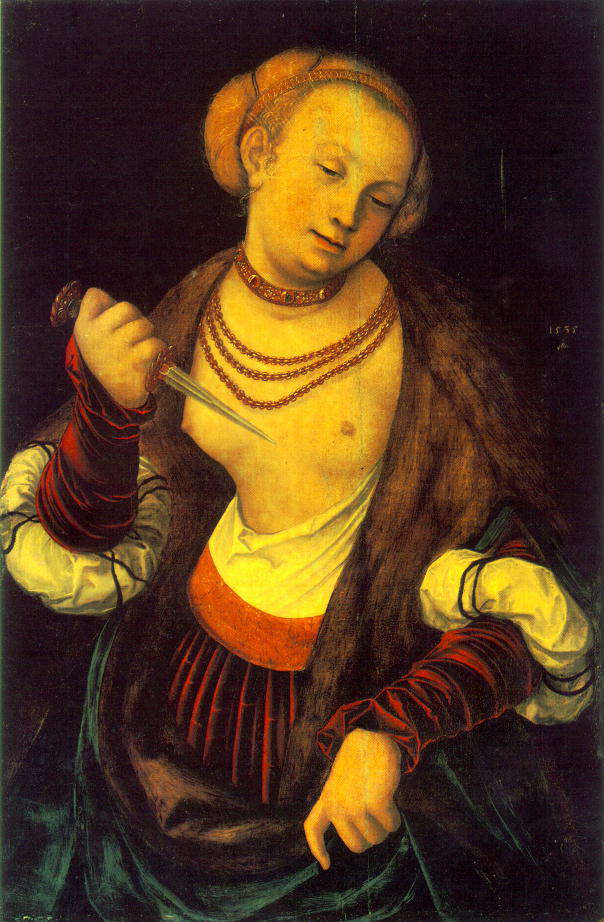
(NB. The painting of Lucretia by Lucas Cranach the Elder is amazing and should be checked out. It also shows that the story of Lucretia and the story of Susanna were simultaneously going through a popular spurt in art in the Renaissance and Baroque period, although earlier depictions can be found.)

Without a doubt, the artists were more than happy to explore the theme of Susanna (and Lucretia) because of the possibilities it offered for a prominent nude female within the painting itself, particularly the bathing scene. What can I say but pervy men, eh? heehee

But seriously check out some of the picture above and see for yourself the artisty involved in just one story.

As another aside to this rather random blog, I have come to love these 'stories', as I shall call them, concerning women and how they upheld their virtue for their husbands, for society and most importantly (often) for God. This says a lot about the time and society in which these pieces of art were painted. Thank you Classical Civilisation A-Level...

(Ok, the uploading pictures seems to be malfunctioning at the moment! I will keep trying though! See here for the early art on Susanna and here for another collection. Hopefully tomorrow this function will be back up and running!!)

Wednesday, 3 December 2008

Charles I: The Ignition for the English Civil War?


I was sorting through some of my paperwork from university, clearly very well organised in a huge box *please hence the sarcasm on that one*. I always seem to be immaculately tidy right up till revision time and then everything becomes tangled and messy, mainly because I could never face the prospect of flicking back through all the paperwork again after the exam just in case I realised I made a devastating mistake!


Anyway, I am deviating again... I came across my last essay for a course in the first year where I got a first. It was broadly named "Society, Culture and Politics in Early Modern Europe" or some such... it was an ace course where we covered everything. It included the English Civil War and working at the castle now, people, who want to know how we came to have a Civil War. It is hard to explain in a sort span of time, without seemingly either lecturing or shortening it to the point of historical criminality where I miss out key bits. Anyway, I often remark that Charles I was his own undoing in some ways... and here my conclusion of my essay I found in my pile of notes explains... Perhaps I could be accused of historical criminality as I am missing out quite a chunk of what happened... but go along with it for me, please??


Unfortunately for Charles I, his reign was based on 'personal monarchy', where his personality determined the style, efficiency and effectiveness of his rule. It was apparent that Charles lacked a strong personality. His readiness to defer duties to others was a dangerous weakness and the flaw that should never be present in a monarch was inconsistency and a bad judge of character. When his main advisor and friend, Duke of Buckingham was assassinated, Charles was left to his own devices. However, instead of getting back onto his feet, he turned to his wife, who he came to rely heavily on. She was all too eager to fill the vacant position of political favourite despite her lack of knowledge of the country she resided in and the fear she invoked in the nation (she was a French Catholic in an unstable Protestant country who also had uneasy relations with the French).


Although Charles was under no obligation to call parliament and they were often only called when the monarch needed them, usually for money. However, Charles pushed his authority too far. He did not call parliament for eleven years and had 'illegally' used Ship Money (which was to be used only for when the Navy needed to be equipped due to a national emergency) to supplement his income, which caused many people to think he was determined to subvert the laws and customs of England, especially when he proclaimed that he had forbidden any one to talk of calling another government. The historian Margaret James argues that the Reformation and the evolution of more democratic political thought have a link. Luther had proclaimed that no Christian should be ruled except by his own consent, a potentially destabilising idea for a monarch who believed in the 'Divine Right of Kings'. Religion had provided a political basis for opposing Charles' rule.


Charles also added to this link between religion and politics. Although he did not think politically, he did think that “kingship was a sacramental concept” and that if he traded parts of it away, like he thought the first parliament he called was asking him to do, he was committing the act of sacrilege. His rule and how he ruled was directly linked to God and religion. He was actually politicising religion further and the saying "If you give a man enough rope, he will hang himself..." the same could almost be said for Charles and his dogmatic insistence that he was handpicked by God to rule.


This ties back into the idea of a 'personal monarchy'. Charles refused to budge on how he ruled and he upheld backward and frail institutions in a religiously divided nation with social and economic problems. The majority of the nation hated the outdated feudal system he insisted on keeping and he was lengthening his own rope. The historian, John Morrill, agrees: “the personal weakness of the monarch could in themselves cause the collapse of order” and it did. Indeed Charles was so inapt in his role as monarch that he agitated matters.

Of course, there were inherent problems in English society which long preceeded Charles I. Henry VIII and the Reformation had unbalanced society long established on the Catholic faith. This religious issue had not been helped by Henry's son and two daughters, who first killed Catholics, then Protestants and then Catholics again for heresy. Social and economic problems had been a long time grievance of the peasantry. The history of religious and social issues with additional current social problems were a key issue and provided a strong base for discontent in society, but I genuinely doubt whether it would generate enough fervour to drive the nation to decapitate their monarch. However, the ministers that helped dispose the King- what was their motivation? They did not share the same despair at failing crops as the peasantry did. They would not starve, just see a dent in their profits. It was political. And Charles. They really had a grievance with Parliament not being called for 11 years. They no longer welded political influence and this is what irked them! Charles failed at keeping the masses happy (there was no rise in real wages, a rise in rent and in food costs and the Poor Law wasn't coping) and also at keeping his ministers happy with regular meetings and any attempt at showing a caring, listening ear.


The revisionist historians, such as Morrill, believe that the ‘revolution’ was caused by the monarchy, not the people, (and also by the Scottish and Irish, not the English, which I will delve into later perhaps). I believe that the offensive prayer book of 1637 forced upon the Three Kingdoms in an attempt to try an unite them is an example of how Charles was politically ignorant and exacerbated already highly strung tensions in his country. Three very different countries with very different religious beliefs. Elizabeth I and James I had never tried to unite them.
Religion and politics were so interwoven that religious reforms have a political context, which Charles did not recognise and this blunder cost him dearly. If Charles had been politically more astute, the social, religious and political problems would have been kept suppressed, as previous monarchs had done. However, Charles’ tactless handling of both social and political problems with the addition of exacerbating religious division created the Civil War. And he lost his head for it.

Friday, 24 October 2008

Does God Exist?


Don't worry... well, that much. It is not a long rambling debate on whether God exists. I am going to type out an essay I wrote when I was 17 and having to jump through the hoops of a course I had to do in the sixth form at my Catholic grammar school. I was just battling with my mam about me becoming more atheist and cynical at the time. Most kids at school did not even bother to finish off the course and write this essay. i was a geek and did. But I think it had more to do with teenage angst. I am still waiting for my certificate from the Archbishop for completing the course...


The arrogance combined with an acknowledgement of having to jump through the correct hoops to pass amused me on digging it out the other day when I was rummaging through my old school work and deciding what to throw out and what to keep.


"Through time human beings have existed, we have been 'obsessed' almost with the question of the existence of God. it is necessary, some argue, that God exists and there is in fact a great design for our lives. In this essay, I intend to answer the unanwswerable question: 'Does God Exist?'


"The ontological argument is a much debated argument for the existence of God. Ontologism is a theory that we have some natural and immediate intuition of God's existence. However, the main flaw of this argument is that we cannot prove the existence of God enough to satisfy the speculative reason. The classical argument was created by St. Anselm of Canterbury, who defined God as 'that than which nothing greater can be conceived'. The idea that one needs a definition of God if only to dismiss God's existence. It is now easy to come to the conclusion that God exists in the mind and because of Anselm's idea of 'that than which nothing greater can be conceived', he has to exist in reality because he is 'greater' than us and he need something in which to compare to. However, with the argument concerning reality, it brings up a whole new philosophical question: What is reality? (If you believe the film the Matrix: "What is real? How do you define real? If you're talking about what you can hear, what you can smell, taste and feel then real is simply electrical signals interpreted by your brain.")


"In addition, the idea of God's existence is necessary to give reason to why we are here. However, Bertrand Russell said that Anselm used the word 'exist' incorrectly. He says that existence cannot predicate and does not exist. So in conclusion to the ontological argument, it seems somewhat unstable and therefore unsuccessful, as definitions are limited and it is difficult to establish a definition for God, especially seeing as we are not altogether sure that He/She exists, let alone what He/She is.


"The idea of 'MOTION', i.e. the passing of power to act as it takes place, implies a first unmoved Mover, who is God, otherwise we should postulate an infinite series of movers, which is absurd. For the same causes, we see them operating in this world imply the existence of a First Cause that is uncaused i.e. that possesses in itself the sufficient reason for its existenceand this is God. Also the fact that contigent beings exist (beings whose non-existence is recognised as possible) implies that the existence of a necessary being... or God. Also the chance of us just appearing with no cause is extremely unlikely (1/1x10133).


"Humans have a concept of 'perfection', so we will need something to compare it to- an absolute standard that is also actual and infinitely perfect, which we associate with God. there is also evidence of intelligent design, which the Universe and our world shows. it implies the existence of a supreme designer- God. The ethical argument is an idea of an internal witness of conscience to the supremacy of the moral law and therefore to the existence of a supreme lawgiver. The aesthetical argument also proves the existence and perception of beauty. This beauty has to come from somewhere and we must have some comparison as we polarise such things as beauty and ugliness.


"The cosmological argument assumes the validity of the principle of sufficient reason amounts to: that it is impossible according to the laws of human thoughtto give any rational explanation of the phenomena of outside experience and of internal conscience. Whatever exists or happens must have a reason for its existence or occurance. If it is used by a scientist and is valid to explain a phenomenom of physics, it has to be equally valid when used for the explanation of the Universe as a whole. Also the theory that certain things are effects and depend on another cause, and these causes can depend on another cause. One must also realise that our species had its origins late in the history of the universe, and from commonly accepted theories, the actual organisation of the universe has a definite beginning. If time had a definite beginning, then we had a beginning, then how did time and we originate? This happening by chance again is 1/1x10133, so extrememly unlikely then!!


"The telelogical argumentis absed on the existence of design in the universe and proves the existence of a supermundane mind of great intelligence and therefore the existence of God. The idea that we exist because of blind chance is absurd. The argument, however, is not weakened by our inability to explain somethings because we have limited knowledge of the entire design.


"The existence of evil could weaken all arguments promoted for the existence of God. Some believe that god balances evil and vice versa. God is all knowing and all powerful and benevolent, but does that make evil the opposite- not all knowing or powerful? It all seems a little hazy and seems like there is no definite answer. Why would God let evil and suffering exist if He/She is all benevolent? However, one could believe that we need to know evil and suffering to know good and happiness, and appreciate it.


"To conclude, there have been many arguments put forward for the existence of God, but there are flaws in everyone of them. I think in the end it is all to do with faith, if you believe or not. I suppose for the majority, we shall have to wait until death, either to tell us the 'truth' or confirm already stated beliefs."


What a cop out conclusion!! haha... jokes....

Thursday, 2 October 2008

A solemn thing- it was- I said-

A solemn thing- it was- I said-
A woman- white- to be-
And wear- if God should count me fit-
Her blameless mystery-

A hallowed thing- to drop a life-
Into the purple well-
Too plummetless- that it return-
Eternity- until-

I pondered how the bliss would look-
And would it feel as big-
When I could take it in my hand-
As hovering-seen through fog-

And then- the size of this "small" life-
The Sages- call it small-
Swelled- like Horizons- in my vest-
And I sneered- softly- "small"!

This peom, like many of Emily Dickinson's, is not to be read on one level. Is it to do with marriage? Highly likely. Religion? Most probably. Death? Again, yes. Each line can be read to prove each theme and this makes Emily Dickinson special. You can read a poem and it mean one thing one time, but the other time it would mean the other thing to you- it is a poem for different moods and since I seem to be on a religious rant at the moment follow this poem along the theme of religion.

By the way I think death is probably the primary interpretation, but argue with me on that as you will. I do! "If God should count me fit" is a definite link to Emily's issue with Calvinism. It was very much at the forefront of her religious insecurity. Calvinist believe that one is predetermined to go to heaven before they are born and no matter what they do on earth can really make much difference. We are inherently good/bad from birth. Emily is very insecure about her own death and whether she would get into heaven. Another link to Emily's thoughts and how this poem represents her life and feelings is that "a woman- white- to be-" refers to Emily being dressed in white all the time when she withdrew from society and become a recluse.

"Hallowed" and "Eternity" all hint at a religious connotation. "Purple" is an ecclesiastical and royal colour. "Plummetless" and "Eternity" make death seem a scary, long drawn out thing. "I pondered how bliss would look" shows that Emily is wondering what heaven looks like. "Seen-through fog-" refers to St. Peter's belief of the 'mist of life' (or something- my bible studies are rusty). "It" to me (in the last stanza) is her life. To her, life is not small. It is everything. The Sages- possibly the saints, angels, God, etc- it is just a small life, but from a personal point of view it is everything.

So, am I right or wrong? I don't know. Perhaps when I meet Emily "in the fair schoolroom of the sky" I will ask what she meant!

(I shall know why- when Time is over-
And I have ceased to wonder why-
Christ will explain each separate anguish
In the fair schoolroom of the sky-

He will tell me what "peter" promised-
And I- for wonder at his woe-
I shall forget the drop of Anguish
That scalds me now- that scalds me now!)

For other poetry on women in marriage and also marriage blurred with religious service as a nun (possibly) see here.

For the Young

I keep asking
"For the things I desire,
You tell me I'm selfish
And "playing with fire"-
It is hard to believe
I am selfish and vain,
My desires seem so real
And my needs seem so sane,
And yet You are wiser..."

This poem attracted me. My penultimate blog is an exact example of this... I am indeed selfish, but thankfully as it is a blog I shan't take it so seriously. However, just something to remind me that my woes and wishes, and desires and dreads are relatively minor. This is a prayer/poem. Insert where I wrote "I keep asking"- "Dear God, I keep praying..." How funny that it struck almost as if someone had punched me on the nose. It made me feel bad. Then I remembered i didn't necessarily believe in this and settled into an awkward feeling somewhat placated by a defensive mechanism that blocks religious turmoil within.

Again another belated teenage angst issue on the question of God that has beleaguered the philosophers for decades, generations and centuries, and by no means do I believe that I can find the answer to which many others have tried... did they fail or succeed I suspect should be left to another blog! I am certainly in no mood to philosophise today!

Poem entitled "A Prayer for the Young and Lovely" by Helen Steiner Rice, "Heart Gifts". At least she thinks our selfishness is "lovely" :D

It is the only road...

Believe not those who say
The upward path is smooth.
Lest thou shouldst stumble in the way.
And faint before the truth.

It is the only road
Unto the realms of joy:
But her who seeks that blest abode
Must all his pwers employ.

Anne Bronte

I found this poem on a bookmark within the pages of one of the books I recently dug out of the shed after we packed a lot of our possessions away when our extension was being built. It was in a book of poems owned once by my nanna, and now by my mum. They can be very religious in tone, but these poems are little gems that make me wish I had a deeper conviction that something wider out there exists than what an agnostic-cum-atheist believes. This poem does not exude a high-toned, preaching voice that tells us we are condemned to hell, but to get to heaven is not easy and we must strive with all our efforts to enter this "blest abode". The conviction of what must be done, the true belief expressed in this lone, short poem shows me how faith really did exist. It did for my nanna, it does in some manner for my mother and today? The next generation? Who knows...

Wednesday, 16 July 2008

Because I could not stop for Death

Because I could not stop for Death,
He kindly stopped for me;
carriage held but just ourselves
And Immortality.

We slowly drove, he knew no haste,
And I had put away
My labour, and my leisure too,
For his civility.

We passed the school where children played,
Their lessons scarcely done;
We passed the fields of gazing grain,
We passed the setting sun.

We paused before a house that seemed
A swelling of the ground;
The roof was scarcely visible,
The cornice but a mound.

Since then 'tis centuries; but each
Feels shorter than the day
I first surmised the horses' heads
Were toward eternity.

I truly love Emily Dickinson; a wacky half feminist, half doubting religious nut who became a recluse and wrote poetry of love, death, nature and womanhood (all the things that are important of course!!) and I completely fell in love with her. Trust me, if there ever was a poet for every occasion, this woman had it! This one is a bit more morose and serious, but I promise the next one will be demonstrating the wackier side...