"Hope" is the thing with feathers-
That perches in the soul-
And sings the tune without the words-
And never stops- at all-
And sweetest- in the Gale- is heard-
And sore must be the storm-
That could abash the little Bird
That kept so many warm-
I've heard it in the chillest land-
And on the strangest Sea-
Yet, never, in Extremity,
It asked a crumb- of Me.
A little thing to keep us going over the iniment looming winter. A sweet little poem.
Monday, 22 September 2008


Riddle by Emily Dickinson

Can you guess what she is describing?
Blazing in Gold and quenching in Purple
Leaping like Leopards to the Sky
Then at the feet of the old Horizon
Laying her spotted Face to die
Stooping as low as the Otter's Window
Touching the Roof and tinting the Barn
Kissing her Bonnet to the Meadow
And the Juggler of the Day is gone
"He didn't resist temptation. He pursued it": The Libertine Culture

 Apart from Johnny Depp being deliciously hot, I love the film the libertine. As historical romps go, it is historically quite factual but what gets me the most is how the film captures the beginning of this type of English culture. Libertarianism.
The libertine culture arose from the reassertion of the "one-sex" theory of sexuality caused by the formation of the materialist ideas that emerged with the enlightenment. These materialist ideas were based on the belief that the only thing proven to exist was matter (resulting in spiritually nonexistent discourse) and therefore sex became, as Erasmus Darwin penned: "the purest source of human felicity, the cordial drop in the otherwise vapid cup of life". The "one-sex" theory in the 18th century was based on these materialist ideas and also the humoral model, which believed men and women were anatomically the same.
The "one-sex" theory promulgated that both men and women were to enjoy sex. They both had the same genitalia according to the humoral model; the male genitalia, due to their dry and hot nature, had descended unlike women's, who were cold and wet and remained inverted. It was for this reason that women were supposed to crave sex with the men to obtain the male's semen because their imperfect organs were unable to produce it. Women were also supposed to enjoy sex because otherwise they would not be able to conceive a child.
Eighteenth century thinkers came to consider the pursuit of pleasure a human obligation. The senses were the primary mediators between the individual and the world, which compelled individuals to avoid pain and to pursue pleasure, which came to license sexual indulgence. The tagline to the film The Libertine, based on the dissolute life of John Wilmot, the Earl of Rochester a notorious rake and poet, was : "He didn't resist temptation. He pursued it". This is interesting. I know that the film is about a man and therefore "He" is a suitable prenoun to use in this tagline. However, I think it also shows, perhaps accidentally, the underlying hypocrisy and gendering of the libertine culture. In theory, based upon the "one-sex" model, men and women are to both equally enjoy sex because they were fundamentally the same. But was this the case? Did all women enjoy this freedom? Or were they called, as they had been for years before a whore or harlot?
Marriage was a mode of business and was not based on the later Romantic ideal of marrying for love. The wife could consider herself free after producing an heir to choose and enjoy other sexual partners, but until the heir was born the wife was under her husband duress. If the husband misbehaved however, it was usually tolerated. This double standard remained a constant throughout the centuries and was not removed fully in this era. Women were still bound to their maternal obligation and materialist libertinism failed to overcome this pillar of patriarchy. It was acceptable for men to keep mistresses and to recognise their bastard children, as men's promiscuity was seen less harmful than women's. The "natural" discourse that had dominated the Enlightenment (eg. Locke and his discussion on the state of nature) both liberated and incarcerated women. It allowed them to enjoy sex but the woman's biological role as a mother was considered a sacred duty and hemmed her back into the her separate sphere of the home.
Yet among many of the female elites there was a brutal frankness and indifference to the religious taboos that had held sway under Charles I's reign and earlier. In Restoration England until the late 18th century elite women rivaled men in their sexual activities, as Lady Mary Wortley Montagu criticises: female adultery was "esteemed a fashionable vice than a crime".
She was not the only one to criticise. Another lady remarks that there was a group of ladies "who would have all been affronted, had you supposed there had been a grain of conjugal fidelity among them"!! This shows that not all practiced this sexual libertinism themselves and many distanced themselves from it, but they unreservedly accepted it as a matter of course. It is notable, however, that these remarks come from the 18th century. Now, libertinism seems to be grating against the English culture, particularly the one to emerge in the late 18th century: Evangelicalism.
The Enlightenment world was still patriarchal. The film The Libertine is particularly good at showing the relationships between men and women in the Restoration era. John Wilmot/Rochester is in control of many of his relationships. His wife panders to his needs unable to do anything about his drinking, sexual conduct and his sharp wit, which got him expelled from Charles II's court for a time. His wife knows what is going on when he is in London but cannot stop him from going there, neither does she have a lover or a sexual life outside of him. London is seen as the centre of vice and folly, and indeed many ways it was with its numerous taverns and brothels. Rochester with his mistresses also demonstrates his complete control over them. "You're not falling in love with me, are you?" He asks. She shakes her head and gives some pithy reply but the audience knows that she is smitten! She dare not say otherwise or she will lose him. In the end however, the woman he truly loves has complete control of him. Love conquers all, I suppose. Regardless of this, she manages to refuse to let him control her whilst he teaches her the art of acting, she doesn't tell him she has a child as she provides her own way, and she makes her own way. However, she is different from Rochester's wife. She had to provide a heir. It was her duty and it was her social status as an elite that hindered her. Arguably she was almost more moral than Rochester's acting mistress. Still, overall the male was in control.
The film The Duchess continues the theme of this licentious sexual behaviour but in the 18th century. The husband here is also in control. He treats her appallingly, but she takes her lovers after this. She is both the neglected wife and the mistress. This film too is based on a real life person, one Georgiana, Duchess of Devonshire in the 1790s who lived in a real life menage a trois with her husband who had taken her close companion Lady Elizabeth Foster, as his mistress. She in turn took a lover, an up and coming political figure for the Whig party. Together, her and her husband, his mistress and her lover caused so much gossip.
Determined to be a player in the wider affairs typically male, she proved that she could out-gamble out-drink and outwit most of the aristocratic men. She helped usher in sweeping changes to England as a leader of the forward-thinking Whig Party. Her power and popularity grew.
But when she tried to be true to herself and loyal to her duties she found herself pushed to the brink of risking banishment by her husband, family and all of London society when her controversies and convoluted association creep up on her. Even she had restrictions upon her life. This libertinism seems a fallacy. Was it really a libertarian society at all?
But when she tried to be true to herself and loyal to her duties she found herself pushed to the brink of risking banishment by her husband, family and all of London society when her controversies and convoluted association creep up on her. Even she had restrictions upon her life. This libertinism seems a fallacy. Was it really a libertarian society at all?
John Wilmot/Rochester ends up dying a most grusome death from syphilis, a reminder of his naughty ways in life. It hardly shows libertinism as liberating in the end. John Wilmot is a character tortured by his own nature and ways. Of course, films aren't the way to judge how it actually was, but they do popularise history and shows the basic facts.
Essentially these are good watches and have a genuine historical basis. I love it! Libertinism is a complicated matter in this time...
Tune in next time folks to hear about the 'change' from libertinism to Evangelicalism and the "moral panics"!
Aha! Taking hold of my life! FINALLY!
Yay! I have been bold and have finally applied for some work experience- I think it is a rather bold move, but hopefully they will take me up on the offer!!
I have had enough of not knowing what I am doing so I have decided to have a go at everything! yay...
yeah, that's it really... XXX
I have had enough of not knowing what I am doing so I have decided to have a go at everything! yay...
yeah, that's it really... XXX
Monday, 8 September 2008
Harry Potter, my one constant in turbulance

I feel I have neglected to write about my one constant and solace in this blog, and as the title of this blog shows their time to shine has arrived... yes, indeed it is the multi-million or rather billion pound character: HARRY POTTER.
Now, I had only just begun to get into reading through the 'Babysitters' books and the Judy Blume young teen reads at around the time the first Harry Potter book became famous (Harry Potter and The Philosopher's Stone for those of you who don't know). I was given it by my best mate who I had known since I was three years old at dance and went to both primary and secondary school with. At that time I didn't know that she would later be the bane of my existence at school whilst she and my group of mates decided they didn't like me anymore on a whim and as childish behaviour goes made my life hell. With all my friends 'turned to the dark side' as it were, I was left alone. (By the way, please no heartstring violins, this is just a true account of events from my rather biased and probably still slightly bitter opinion!!)
Now Harry had entered my life and I was grateful. I sat reading in the library devouring each word, the witty repartee between the three main characters, the tussle with Draco Malfoy and the adventures they experienced rather wishing I could be at Hogwarts rather than my school. Now it was here that I met a fellow 'reject', who sat in the library avoiding those who are far too cool to ever enter the library even to pick on the wimps!! Now, we bonded in our mutual geekiness and our new founded love of reading Harry Potter. She loved to criticise it and I loved to praise it! We rocked around the school in our own world, okay so it was mainly hanging out in the library with Mrs Lord, the generally hated librarian, who gave us the newest books she had just bought and recommended some of the best books in the world I have ever read. (Well they were poignant at the time!!)
I missed out the second book for some reason and I read the third book first, then when my brother got the second one for Christmas and I saw it was being abused i.e. being used to prop up his various piles of junk in his room, I stole it and read it! It was amazing! Even better than the first I thought! The adventure was getting even more dangerous!! But I am not entirely sure that was what captured my heart. I held a bias for this book because it beat being me hands down! True, I didn't have a psychopathic wizarding killer after me but sometimes I thought at least I knew what I was fighting if I was in Harry Potter land.
It was the Christmas 2000 I received the fourth Harry Potter book as a present the following day my parents split up. The book was my comfort. It amazes me now how I can set my life against the publishing of the Harry Potter novels. In 2003 I believe the fifth book was published alongside this event, almost to the date, my parents got back together. Now I realise that it was just a coincidence, but believe me it was comforting to know that a fictional character though he might have been was having ups and downs of his own. In the meantime I learnt to almost memorise these four books with scarily accurate precision! thankfully now I have moved on to read other things and become slightly less obsessive!
Now I am rereading the Harry Potter series again for the umpteenth time and believe me I doubt it will be for the last time. I have worked out that they are still very much a part of me and I can see what I saw in them and I am still finding new bits out, discovering pieces that make me laugh and make me cry that hadn't before. Today, however, I read it for fun not for escapism (though arguably reading is escapism). I can set store my life by these books and I have been every character within them, starting with the bullied Neville Longbottom, to the comic and most insensitive of characters Ron Weasley, to Harry himself the head of the group, the troubled one and most prized, to feeling like Hermione, clever but not amazingly brave like Harry, or funny like Ron, to today where I know resemble a mix between Dumbledore and Snape. It is an awkward mix I should probably explain more but for the fear of exposing myself too readily on the internet I shall just say I have the ounce of badness that was in Snape, mixed with the warped pure desire to have what he loved, and then Dumbledore the quiet noble hero with somewhat of a blind spot, a habit to make grave mistakes and perhaps thinking he was too smart for his own good but otherwise is a good judge of character. It goes deeper... but let's leave it there tonight folks!
Overall, Harry Potter has been praised for its mastery in bringing kids literature back too life, for getting kids to read again and for mingling adult and children fiction in one. On the other hand, it has been damned in America for its heathen manners (hum... mebbe another blog is due on this!!) and by others for its poor literary quality and banal plotting etc etc. Either way you can't claim that all those millions of copies of books sold in many different languages, with the popularity it has made in book, film, game and merchandise that it cannot be a poor read. Something must draw the masses... perhaps each of us a personal attachment to the books and for that they should be praised and JK too for reaching to the child and adult alike!!
Signing off... Night XXX
Charlotte Bronte and Jane Eyre I: Ahead of Her Time?

I have completely fallen in love with Jane Eyre, the supposed plain governess who dares falls in love with the master. Charlotte Bronte stirred up a hornet's nest with her plot involving Jane returning to Mr Rochester not knowing that his wife had died (sorry for ruining the plot for those who have not read it- I should have put a plot spoiler warning before I started!) This was shocking for her time when a woman's character was the basis of maintaining her social status and that hinting at the possibility of fornication and/or adultery was seriously frowned upon in this rising moralising middle class, which was forming contemporaneously to the writing of this novel. It is especially shocking for the reader even today that Jane returns to Rochester because she represents the moral conscious of the book (especially when contrasted to such characters as Rochester who has led a dissolute life in some ways and Bertha who is mad nymphomaniac.) This slightly unusual deviance from the accepted norm is something I loved about the novel. Charlotte Bronte's mouthpiece, Jane, expostulates some rather forward-thinking ideas, which really grabbed my attention:
"Women are supposed to be very calm generally: but women feel just as men feel; they need exercise for their faculties, and a field for their efforts, as much as their brothers do; they suffer from too rigid a restraint, too absolute a stagnation, precisely as men would suffer; and it is narrow-minded in their more privileged fellow-creatures to say that they ought to confine themselves to making puddings and knitting stockings, to playing on the piano and embroidering bags. It is thoughtless to condemn them, or laugh at them, if they seek to do more or learn more than custom has pronounced necessary for their sex."
I was initially grabbed by the equalising tone of this passage; that women require a similar freedom to what their "brothers" possess. The more recent version of feminism has alienated society and particularly men with the often antagonistic pronouncements that women are better then men. As an aside, I disagree, and in fact we are beginning to replicate the 'male oppressors' of old and equality is most definitely no longer what a lot have feminists have sought. They seek to surpass this. However, getting back on course.... Jane Eyre, or more particularly Charlotte Bronte through Jane, explains her own restricted feelings of a woman who could have no other role in society other than a governess or a wife. This passage proclaiming women's equality to men is really unique. It was written at a time when feminism- loathing to use such an anachronistic term-was really just kicking off; women were beginning to question their confined roles.
I believe Charlotte wrote Jane Eyre as a firm critique of society by showing what life was like for a woman bound by few options and also that to achieve happiness that some things would have to be sacrificed- like Jane's morality. In this view it seems a grim portrayal, but to the readers reading Jane Eyre today, we think "Good on her" since our moral values have altered somewhat over time. Still we still recognise the confinement of women in this time, with this moral obligation and of this class.
So, Charlotte Bronte the premature feminist? Maybe, but she definitely was a woman wanting more for her sex!
Saturday, 30 August 2008
STOPES- CHAPTER I PART II: A Woman's Right to Orgasm!
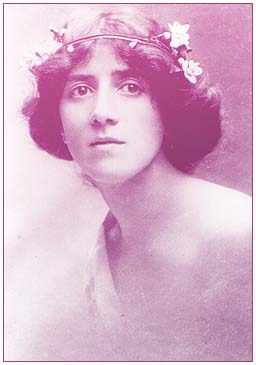
In the sample of letters studied, there were numerous letters from men, who wrote to Stopes asking how they could make their wives enjoy sexual intercourse: “I love my wife very dearly Dr and have longed so to see her be as happy as I can make her”. This shows that there was a dramatic change in the relationship between husband and wife. The wife often wanted a “complete union” and the husband wished to satisfy his wife. Thirty-one respondents wrote to Stopes asking for advice on their sexual problems, and notably they are nearly all men. Eighteen respondents asked for advice on marriage issues and it shows an active concern to create the ‘ideal’ marriage that Stopes illustrates in her manuals. Holtzman noticed in her sample of correspondence that there was a significant amount of women, who were disappointed about their inability to experience sexual pleasure: “We have tried every way to have a complete union which will bring me the desired result.” Holtzman’s female respondents’ dissatisfaction in the lack of sexual pleasure indicates that they shared a common expectation about the universality of achieving sexual pleasure. Stopes’ ideal of the perfect marriage, it seems, was unobtainable by many.
Nonetheless, the influence of Married Love cannot be denied. Those who did manage this “mutual adjustment” received the full benefit of a happier and equal marriage. Those who were unable but were seeking to achieve “mutual adjustment” shows that there was an active willingness to change the relationship, which indicates progress. As a result of an absence of contact with other sources, Married Love had a more far reaching impact on women than just forming their expectations of marriage and sexual intercourse; it gave women the vocabulary to discuss their sexuality. Holtzman discovered that the language used by the women in their letters was very similar to that of Stopes’ books. I also found in my sample of correspondence that many used terms like “complete orgasm”, “union” and some even quote her book back to her, perhaps embarrassed or uncertain to describe their own sexuality and problems. Stopes even recognised that Married Love was influential on the language of sexuality: “its phraseology become part of the national vocabulary”.
Stopes’ main influence, Holtzman argues, was on women in interwar society with her creation of a sexual role for them within marriage, especially considering the social changes that were occurring in the aftermath of the First World War. Women were encouraged to give up their jobs and return to the domestic sphere. High rates of unemployment, the rise of contraceptive technology coupled with uncertain times meant that there was a declining birth-rate in the middle-classes, which caused the female role as mother that had dominated the domestic sphere to become increasingly less important. With reducing significance of motherhood as women had fewer children combined with the decline in economic independence outside of marriage, Stopes provided middle-class women with a sexual role. This attracted middle-class women who felt that their traditional roles within the home were becoming less significant. Holtzman argues that Stopes was just enhancing an existing sense of power, because there had been a steady decline in the birth-rate within the middle-class due to women asserting sexual authority in the absence of widespread contraceptives. Holtzman’s argument is interesting, but she neglects the sexual role of women had a wider connotation than merely replacing diminishing roles within the home. Holtzman undermines the importance of the sexual role making women equal partners in marriage and ignores Stopes wish to further female equality in marriage, so women could “possess as much intellectual freedom and freedom of opportunity within it as do their partners.” In her study of Stopes, Holtzman neglects working-class women.
Marie Stopes never wrote or directed any part of her two marriage manuals, Married Love and Enduring Passion, to help and reform working class marriages. Many of feminist arguments were derived from the feminist movement, which was primarily a middle-class movement. Feminism only had a diffuse impact on the working-class women when Stopes used it to support the limitation of working-class children. The emergence of marriage manuals like Stopes’ Married Love and Enduring Passion (1928), which explicitly referred to sexual intercourse as something to be enjoyed not just for reproduction were intentionally addressed to respectable middle-classes. This did not mean that the working-classes, particularly women from the artisan and ‘skilled’ section of the working-classes, were not exposed to her marital ideology. Since the late-nineteenth century, ‘skilled’ labourers of the working-classes benefited from increasing wages allowing them to afford, in theory, Stopes’ books.
Although Married Love had a limited readership, its popularity ensured that many knew about her ideology. Stopes’ ideology was revolutionary as it promoted female liberty and sexual pleasure in marriage, but at the same time it was in some ways still very conservative. Stopes only advocated heterosexuality and marital sex. In the interwar period there were advocates of free love and homosexuality, which did not base their ideology of sexuality within marriage, but Stopes’ was not revolutionary enough to support such a controversial issue. Hera Cook argues that Stopes did not extend sexual equality as far as she could have as she did not advocate in any of her works that women should dominate the sexual relationship. Instead Stopes advocated equality of the sexes in marriage. Women were no longer sidelined as the domestic, passive and weaker sex:
“This ancient weakness of her sex must be conquered, and is being conquered by the modern woman.” Women became an active partner in the marriage relationship and Stopes notes how hard it is for “two people of different opinions to retain their own opinions without each other endeavouring to convert or coerce the other”, but essentially it is what marriage should be like:
"While modern marriage is tending to give ever more and more
freedom to each of the partners, there is at the same time a
unity of work and interest growing up which brings them together
on a higher plane than the purely domestic one which was so
confining to the woman..."
Stopes acknowledges that the restricting shackles from the “shadow of the coercive and dwarfing influences of the past” were being eschewed for female freedom: “one sees a widening of the independence and the range of pursuits of women.”
Marie Stopes’ Married Love transformed the marital relationships of those who read it. While Stopes agreed with feminists, who argued that marriage should not give the husband the right to demand sexual intercourse, Stopes broke away from the feminist acceptance of the common belief that women were passionless, which only served to reinforce conjugal rights. Stopes depicted the female body as actively sexual at a physiological level, and combined with her theory of periodicity, she gave women the chance to refuse or accept her husband’s sexual advances without been named “frigid” or “depraved”. Stopes’ separation of sex and reproduction was a novel creation and gave women a sexual identity of their own. This manual opened up discussions between husbands and wives on sex, birth-control and marriage. Perhaps Stopes was not as revolutionary as many were in her era but her policies were controversial and made an impact.
F.Y.I: This is copyrighted ©
STOPES/CHAPTER I PART I: A Woman's Right to Orgasm: Equality and Mutuality in Marriage
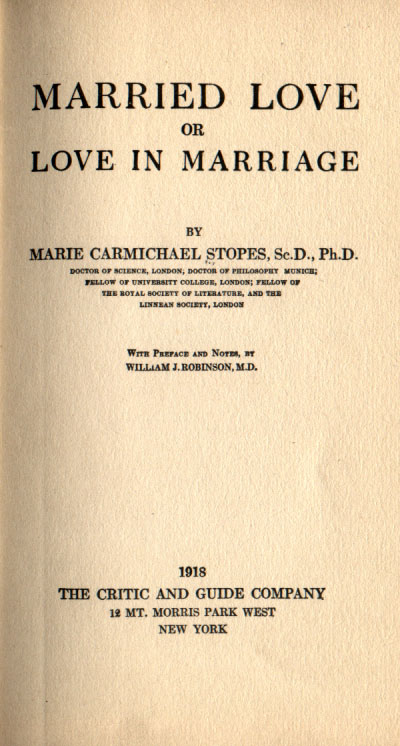
Marie Stopes wrote Married Love to “electrify England” and it succeeded in its task. By 1937 820,000 copies were sold worldwide. Her book was not the first or last manual on marriage and sex, but, as Hera Cook states, it transformed the discourse on heterosexual female sexuality and sexual practice. Stopes had no tradition to draw from to construct the ideology of an independent and emotionally active female sexual identity, which was formed separately from their reproductive capacity and from male’s sexuality. Creating a female sexual identity and role separate from reproduction was a major innovation. Before the development of effective contraceptives, nineteenth-century sex and marriage manual authors placed sexual activity alongside reproductive physiology reflecting a connection between sexual and reproductive roles for women. Birth-control was the crux of ‘married love’ which allowed pleasurable sex without hindrance of conception. Married Love was sparse in conveying details about birth-control because Stopes wanted to keep women’s sexual and reproductive roles separate. It was Wise Parenthood published later in the same year that provided the necessary details.
Married Love was unique in that the response Stopes received from women was phenomenal. Thirty-three respondents from the sample of letters studied wrote to Stopes to express their gratitude that finally someone seemed to understand not only the sex relations but the marriage relationship too: “it seems so wonderful to think that someone really knew love and understand as we do.” Married Love was written to promote equal and mutual enjoyment of sex which would provide a basis for a happy, successful marriage. Stopes noted that she knew that “in the middle classes in this country, marriage is far less happy than its surface appears” and it is no easy task to produce a successful marriage, especially when ignorance reigns causing despondency and ruptures in marriages all over England. Stopes established women’s sexuality and formed a sexual role for women within marriage, which was a departure from Victorian ideals that proposed women had no sexual feeling at all. Women in the past have been modelled to represent their husbands’ and society’s ideal wifely qualities:
"Woman’s side of the joint life has found little or no expression. Woman has been content to mould herself to the shape desired by man wherever possible."
The foundation of Stopes’ ideology in Married Love is that men and women are equal in marriage: “we are incomplete in ourselves; neither man nor woman can singularly know the joy of the performance of all the human functions”. Stopes argues that women should be treated as equal, intelligent and sexual beings. The notion that “sex-life is a low, physical, and degrading necessity which a pure woman is above enjoying” is completely rejected by Stopes as a “deeply rooted” social construction based on the idea that female ‘ignorance’ was really an indication of ‘innocence’ and ‘purity’, as one respondent highlights: “Parents, confusing “ignorance” with “innocence” are eternally threatening their daughters in the belief that ignorance combined with fear will safeguard their chastity.” Stopes argued that women were sexual creatures who had a right to satisfaction as well as men:
"Welling up in her are the wonderful tides, scented and enriched by
the myriad experiences of the human race from its ancient days of
leisure and flower-wreathed love-making, urging her to transports
and to self-expressions..."
Stopes showed that women could be sexual beings and it was above all natural. It was not depraved for women to want and enjoy sex.
Stopes argued that man has “used woman as his instrument so often regardless of her wishes” and he should alter his sexual technique to accommodate his wife’s needs. Even many feminists remained disinterested in questions related to female sexuality, which makes Stopes rather progressive in comparison to her contemporaries. Feminists’ main sexual issue was to emphasise a high moral code for women based on a belief in sexual control and chastity upon men. Stopes did adopt the idea that men should restrain themselves, as “it is his duty to do so, not only when his wife is ill, but also during menstruation and pregnancy”, but rejected other feminists’ endorsement of abstinence as women were sexual beings too and it would deprive women of the healthy benefits of sex. This revolutionises the perception of women in society from asexual acquiescent wife to an individual with sexual feelings parallel to a man. Stopes hoped the propagation of her ideology would diverge from the tradition of woman being used by her husband in the name of ‘marital rights’, which Stopes acknowledged that law and custom had strengthened. The husband had “the right to approach his wife whenever he wishes, and that she has no wishes and no fundamental needs in the matter at all.” Stopes combated this long-standing social construction with her Law of Periodicity of Recurrence of Desire in women. This law stated that women had ‘sex-tides’ and felt naturally more aroused at certain times of the month than others and the man was to use this tide to gauge his sexual approaches. The Law of Periodicity gave a biological mandate both to women’s rejection of a husband’s demands for sexual intercourse and to Stopes’ claim that women could desire sex for pleasure. It meant that women could desire sex at times determined by themselves and could ‘submit’ to their husband’s demands without being “lowered” but still maintaining the right to refuse on other occasions. This ultimately gave women the right to control the frequency and timing of sexual relations. Stopes argued that for the husband to enjoy the sex act and make his marriage a happy, contented relationship of harmony, companionship and love, he should always seduce his wife: “The supreme law for husbands is: Remember that each act of union must be tenderly wooed for and won, and that no union should ever take place unless the woman also desires it and is made physically ready for it.” Stopes explained that if a man disregards his wife’s wishes then “it is rape for the husband to insist on his marital rights” and subsequently he will make the act repugnant to her thereafter. This radical idea was increasingly adopted in the interwar period by feminists, but Stopes made it respectable by explaining that ‘married love’ and successful marriages depended on this equal negotiation between partners.
Stopes propagated the woman’s right to orgasm within the sexual relations of marriage. The removal of sexual intercourse from the notion that it was for procreation to the idea that it could and should be pleasurable for women was revolutionary. Women’s sexuality was now firmly established in its own right separately from that of the woman’s reproductive capacity. Stopes advocated “mutual adjustment”, which is “where the two are perfectly adjusted” and can reach a mutual orgasm. This equal share of enjoyment in sex is truly significant as women become equal to men in sexual relations. Stopes breached boundaries that had never been crossed by other sex and marriage manual authors before. She discussed the husband’s inability to abstain the moment of orgasm until his wife was ready: “the man’s climax comes so swiftly that the woman’s reactions are not nearly ready. And she is left without it.” Stopes severely criticised coitus interruptus because it meant that women were left “in ‘mid-air’” and therefore unsatisfied. Although men get the complete sex-act through coitus interruptus, it deprives women of the man’s secretions, which Stopes claimed were beneficial to a woman’s health. To stop this Stopes stressed the idea that men should alter their sexual technique to increase female sexual pleasure focusing on foreplay and prolonged intercourse enabling women to have the benefit of an orgasm without the concern of becoming pregnant because the married couple would be practicing birth-control.
F.Y.I: This is copyrighted ©
Friday, 29 August 2008
Introduction to Marie Stopes- My dissertation 'marvel'!!!

As a famous paleobotanist, notorious author, birth-control pioneer, eugenicist and feminist, Marie Stopes was certainly a controversial character. Sex education and birth-control is something many of us take for granted today. Where would society be today if women could not restrict the number of children they had? Many would pinpoint the 1960s as the watershed in contraceptive technology and promotion, but it was from the late nineteenth-century that birth-control began to be considered as a serious social movement in the British Isles. Marie Stopes personalised the movement and promoted birth-control by constantly publicising herself, her works and her clinics. She not only achieved more than any other birth controller, but revolutionised marital relations and motherhood, which changed women’s lives.
Marie Stopes lived in a time of great social change for women in England. The feminists’ pre-war political efforts and women’s war effort resulted in women being emancipated in 1918. The following year a Sex Disqualification Removal Act was introduced, opening higher levels of civil service, legal professions and jury duty to women.
N.B. However, the political emancipation was restricted to women who were above the age of thirty, owned property or were the wives of householders or occupied property with the annual rate of £5 and had a graduate degree. It was by no means universal suffrage, as it is clearly restricting voting rights to middle class women, unlike men who, no matter their class, could vote.
These gains combined to raise the question of a possible increase in female opportunities and Married Love (1918) was published amongst this expansion of political and economic opportunities for women. With Stopes promoting sexual pleasure, it seemed a revolutionary time for middle-class women.
The first half of the twentieth-century was also a time for heightened eugenics fear. The emancipation of some women paralleled the increased anxiety on the ‘Condition of England’ question. Reconciling women’s demands for greater political and economic equality with the needs of the race was one of the most troublesome eugenicist issues. Independent women were eschewing the typical domestic role as wife and mother. The Great War was a eugenics nightmare. It supposedly destroyed the finest physical and mental stock of the nation and disrupted family life and selective reproduction. In Britain there was a particular emphasis on the idea that certain areas of the working-class were degenerating the nation. There were variants of eugenic principles. The worst was ‘negative’ eugenics, which was more authoritarian and used coercive measures to decrease the propagation of ‘bad stock’ and was based on racism, and classism to produce a strong ‘race’. Stopes combined the ‘negative’ principles with ‘positive’ principles, which promoted those who she considered ‘good stock’ to have more children. She had strong eugenic principles and was a member of the Eugenics Society, but she participated in the middle-class feminist movement. Stopes combined these two strains of influence to form an agenda that she thought would benefit all women. This dissertation will argue whether her eugenics or latent feminist principles steered the course of her work and whether she revolutionised society through her ideology on marital relations, publicity of sexual knowledge and promotion of birth control.
Marie Stopes has not suffered from historical neglect. There have been four biographies on her, two of which were from very close friends and their objectivity has been questioned. The first biography was written by her ‘would-be lover’, Aylmer Maude in 1924 and he clearly admires her, which no doubt contributing to Stopes’ publicity campaign. The second biography was written by Keith Briant in 1962. He was another of her ‘would-be’ lovers and writes from a sentimental point of view four years after Stopes’ death. Neither of these biographies historically analyses Stopes and talk of her objectively. The third was written by Ruth Hall (Passionate Crusader, 1977). She is a journalist and she focuses on Stopes’ sexual and emotional experience that provoked her varied career. She just assumes that Stopes helped women with their sexual, marital and contraceptive needs and focused very little on Stopes’ role in the birth-control movement. June Rose, a professional biographer, wrote Marie Stopes and the Sexual Revolution (first ed. 1992), which focuses on Stopes interweaving public and private life.
My dissertation is an analysis of how revolutionary Stopes’ work was on changing marital relations, sexual knowledge, and promoting birth-control. I will not discuss why there was a fertility decline or why limiting births happened uniformly in Great Britain. I intend to explore women as one gender and discuss to what extent Stopes revolutionised social ideals of marriage, sex and birth-control. Women have never been looked at as a whole by previous historical analysis. Contrasting the class variations of Stopes’ influence will give a more balanced overview of her work revolutionising women’s role within marriage and society. I have contrasted Stopes’ works and her correspondence to see how influential her ideology was on women and if it changed society, which has not been explored before. I will also study the conflict between Stopes’ eugenicist principles and her concern for women’s health and happiness. Eugenics hugely influenced Stopes’ aims and affected the way Stopes’ helped women. Many historians have argued her to be either a feminist or a eugenicist. I believe that for Stopes they were indistinguishable, I will argue that Stopes combined her feminist and eugenicist principles. She may have had different aims, race regeneration and happy domestic life with sexual pleasure and voluntary motherhood, but there was one means: birth-control.
I study whether marriage became an equal partnership as Stopes’ promoted and whether women actually achieved sexual fulfilment. I use Stopes’ marriage manuals and correspondence to see how far her ideas of sexual fulfilment and equality in marriage were adopted across the classes. I discuss how Stopes combated sexual ignorance, which was causing unhappy marriages, high birth rates and weak, exhausted mothers. I examined what Stopes wrote in a wide variety of books and then contrasted them to my sample of correspondence to see how many were grateful for the knowledge and asked for more information. Whether the plea for more information was an indication that the information in the books was not sufficient is discussed and how publicity, her clinics and newspaper articles contributed to the dissemination of sex and birth-control information. There is also an in-depth discussion on what steered Stopes’ promotion of birth-control; was it for the race or women’s health and happiness? I look at Cohen’s argument that the clinic was the instrument through which Stopes helped women regain control of their fertility. I have also looked at what Stopes wrote, particularly her eugenicist tract Radiant Motherhood, and how this affected her influence on reforming society for women.
Using Stopes’ own published works, there are many pitfalls. What Stopes may have publicly advocated in her books did not necessarily correlate to her actions in the clinics or in her correspondence. Stopes was a self-aggrandising publicist but her sympathetic tone in correspondence and her policies in the clinics did not show her ardent eugenicist drive as many of her books did. It is hard to know whether the sample of correspondence used in this dissertation is representative of society at the time. The respondents were predisposed to be in favour of birth-control and voluntary motherhood. The majority of respondents were middle-class therefore the other classes are disproportionately represented making it difficult to achieve a balanced overview. Despite this, it is possible to achieve an overall sense of how far Stopes revolutionised society for women. Stopes may not have helped every single woman in society, but those she did help have an experience worth studying.
The overall conclusions to be drawn from this dissertation are that Stopes was a social reformer, not a revolutionary. She tried to break social barriers that maintained sexual ignorance and publicised such topics allowing the free dissemination of information as well as changing marital relations. Stopes did help both middle and working-class women by her publicising information through different media. Those who came into direct contact with Stopes, through her work, letters and clinics were helped to gain control of their fertility. Stopes helped women but not uniformly. In hindsight it seems she stayed rather conservative, as she did not promote issues too deviant from the social norms, but in the 1920s and 1930s she was seen as controversial. Stopes was a social reformer, who through birth-control achieved her feminist and eugenicist objectives of happy marriage, voluntary motherhood, universal sexual knowledge and race regeneration. For Stopes, there was no distinguishing between her eugenicist and feminist principles, which were so intertwined.
More to follow.... mwhahahahahaha....
Tuesday, 12 August 2008
WHAT I A COMING TO REALISE
As previously mentioned in other blogs, it is a weird time of life for me. However, in that time, a few things have occured to me in the arrangements made for my somewhat forced-upon-me birthday party. (A Forced Birthday Party makes me seem harsh or those bestowing it upon me seem harsh, but either way I think I am grateful for it in brushing my path clear of clutter I was unsure of, namely in the way of friends.) Now I do not mean this in the meanest way, nor do I think those that will turn up are my keenest friends, but rather those who like to have a good time, hopefully in fact like my company and indeed want to catch up with fellow folk from uni and school alike, will come.
In some respects I am disappointed in those who will not come, namely my Nan and Grandad but nothing new there and my dad more than makes up for their absence in a calming, demonstrative manner that seems to sooth and relax me. He is a diamond in the rough if ever there was one! My mother in other ways makes up for twenty other people in temrs of vibrancy and volume, but never would I be without her supportive and exuburant nature; always one for the party in life no matter what the cards may deal in life! In others, friends who simply can't make it, and because I am one never to hold a grudge purely because I generally can't due to a lack of a good short term memory- I am sorry, you will miss out on what I hope will be a good night, but I truly hope it won't be the end of the path for us!
So to conclude on what will probably be an empty blog, that none for those who it was directed at shall read, I adjourn with hope that life holds suprises, and in that which it doesn't, the best of my love for those around me. It is a far out cry from the bullying days of school and God! How I have grown! Only that it had been five years ago! But for now to the future and the nearing celebrations on my 21st birthday: CHEERS!
Subscribe to:
Posts (Atom)